Showing posts with label FILM. Show all posts

5/18/12

FILM REVIEW: Goodbye Party

Entrance
Directed by Dallas Richard Hallam and Patrick Horvath


By Alexander C. Kafka

Mumblecore meets mayhem in the terrifying, clever new indie horror film
Entrance, directed by Dallas Richard Hallam and Patrick Horvath.

Shot mostly in a producer’s house, this shoestring project is an odd hybrid of character study and slasher pic. Throw sleepless nights from Cassavetes, Polanski, De Palma, and Dario Argento into a blender, add a strained cup of Tobe Hooper bloodlust, and press Grind.


Suziey Block in "Entrance"
As character study alone, Entrance would be notable for its naturalistic feel and subtle, poignant acting, particularly by lead Suziey Block. And as slasher film—though I confess to being more ambivalent, upchucky bystander than devoted connoisseur of the genre—Entrance holds its own in the shock and effects categories. (Makeup artists Chelsie Hite, Michelle Michalak, and Angel Wen, thanks for helping me lose a pound by putting me off dinner tonight.) But the film’s real canniness is in combining the two, lulling us with its languid, borderline snoozy, this-is-happening routines before walloping us with matter-of-fact this-can’t-be-happening terrors.

Though perhaps destined for a late-night VOD and Netflix-streaming niche audience, Entrance is a worthwhile ride beyond that and whispers more visible promise ahead for its principals. Block, particularly, who has been largely consigned so far to horror ingénue roles, demonstrates a quirky, graceful presence that could contribute mightily to more mainstream dramatic fare.

She plays Suzy, a disenchanted, isolated twentysomething in LA, with a dead car and a dead-end job in a coffee house. She has friends, but as she hangs with them in hipster bars, she looks bored, like she’s going through the motions. Ditto with sex, if the gloomy one-night stand we witness is any indication. Suzy’s not in a rut; she is a rut—less a human being than a melancholy spreadsheet of chores and disappointments, relieved only by glasses of wine and care for her dog. Like some estranged, morose half-sister of Zooey Deschanel, Suzy has straight, jet-black locks, and disenchanted, hopeful almond eyes beseeching from a passive pale face. She needs a hug, and not the kind the guys in the bars want to give her either.

When her dog disappears, Suzy crumbles, curling up on the couch with snapshots from better times. Weirded out by strange house noises, some men harassing her on the street, a car that may or may not be tailing her, she tells her housemate Karen she’s going to move out. Karen arranges a goodbye party for her. And if Suzy—now dolled up in a dashing green dress, with a little extra attention to her makeup—has felt unloved in the City of Angst-Ridden Angels, one of the guests proves otherwise, that there is indeed someone who would do anything to have a quiet moment alone with her.

Entrance is a little clumsy at times—the tailing car and a strobe-flashing midnight lurker undermine the more effectively subtle intimations of perhaps warranted paranoia. And Hallam and Horvath would have done better to drop, literally, the predator’s mask, which works better as the dresser-adorning doppelganger for Suzy’s disturbingly affectless stare. No doubt too the film’s slow burn will try some viewers’ patience, though it’s as much a part of the movie’s mechanism as a slingshot’s gradual pullback.
Overall, though, with its violence as truthful and unhyped as its characterizations, it will leave a nasty cut in your memory. And next time you’re at a casual get-together where post-collegiates play alt-rock on vinyl and chat and frolic like it’s all good, consider the possibility that some of it isn’t.

10/24/07

Film in Focus

Gone Baby Gone
Director: Ben Affleck. Screenplay: Ben Affleck, Aaron Stockard, based on a novel by Dennis Lehane. Cinematography: John Toll. Film editing: William Goldenberg. Production design: Sharon Seymour. Music: Harry Gregson-Williams. Producers: Ben Affleck, Sean Bailey, Alan Ladd Jr., Danton Rissner. With: Casey Affleck, Michelle Monaghan, Morgan Freeman, Ed Harris, John Ashton, Amy Ryan, Amy Madigan, Titus Welliver, Michael Kenneth Williams, Edi Gathegi, Mark Margolis, Madeline O’Brien, Slaine, Trudi Goodman, Matthew Maher, Jill Quigg, Sean Malone, Brian Scannell, Jay Giannone, William Lee, Jimmy LeBlanc, Kippy Goldfarb, Elizabeth Duff, Cathie Callanan, Cameron Henry, Bobby Curcuro, Matt Podolske. US. 113 min. 2007.

By David Sterritt

Ben Affleck scores impressively in his feature-directing debut, thanks partly to his brother Casey Affleck’s inspired performance as a private eye who’s hired by a working-class family to energize the search for their kidnapped child, whom they suspect the police department has given up as lost.

The movie’s grim verisimilitude is further enhanced by director Affleck’s refusal to soften the story’s many tragic twists and to compromise the desolation of its darkest scenes or the confusion of its most chaotic moments. He and coscreenwriter Aaron Stockard also deserve credit for letting the characters speak in realistically crass language; as someone who lived in the Boston area for years, I can testify that every four-letter word rings true, and the ten- and twelve-letter ones do too.

On the downside, there’s a gaping hole in the plot (why don’t the cops examine the corpse in the quarry?) that weakens the picture’s second half, and another that does the same for the denouement. These flaws aside, though, Ben emerges here as an extremely promising director, and Casey consolidates his position as one of the most exciting young character actors in Hollywood today.

10/22/07

Film in Focus

Photo Sharing and Video Hosting at Photobucket

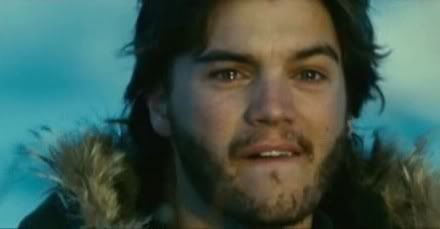
Into the Wild
Director: Sean Penn. Screenplay: Sean Penn, based on the book by Jon Krakauer. Cinematography: Eric Gautier. Film editing: Jay Lash Cassidy. Production design: Derek R. Hill. Music: Michael Brook, Kaki King, Eddie Vedder. Producers: Art Linson, Sean Penn, William Pohlad. With: Emile Hirsch, Marcia Gay Harden, William Hurt, Jena Malone, Catherine Keener, Hal Holbrook, Vince Vaughn, Kristen Stewart, Brian Dierker, Zach Galifianakis, Thure Lindhardt, Robin Mathews, Haley Ramm, Bryce Walters, Steven Wiig. USA. 140 min. 2007.

By David Sterritt

Sean Penn took on a real challenge when he decided to adapt Jon Krakauer’s eponymous book, which tells the true story of Christopher McCandless, a gifted and idealistic young man who finished college with flying colors, donated all of his savings to charity, and hit the road like a modern-day Jack Kerouac, hitchhiking from one short-term stopover and part-time job to another. Eventually he reached his final destination in Alaska, where he lived successfully off the land until a couple of unforeseen errors caused his death.

Penn‘s approach to this material is different from Krakauer’s in important ways. For starters, Krakauer reveals McCandless’s death at the get-go, while Penn saves it for the end, evidently hoping that suspense over the outcome will hook audiences more deeply into the tale. This is naïve; lots of people have read the book, and the paperback edition even puts the passage about McCandless’s demise on the cover. Yet it prefigures the conventional storytelling tactics of the picture as a whole, which replaces Krakauer’s clear-eyed pragmatism with high-key movie emotionalism.

Viewers unfamiliar with the film’s source won’t make such comparisons, of course, but they may be perplexed by some of the picture’s details. An example: McCandless is enough of a cultural rebel to give away one pile of cash and set fire to another when he enters the wild, but he’s not enough of a maverick to have sex with a sixteen-year-old girl who practically dragoons him into her bed. So is he a freethinking radical or not? This question is resolved in the book--to McCandless the girl was just another teenybopper, not interesting enough to be attractive--but in the movie it’s hastily and skimpily explained. (It doesn’t help that Tracy's played by a gorgeous actress who looks more like a movie star than a trailer-park waif.) More examples: Penn injects unneeded sentimentality into a sequence about McCandless’s friendship with an old man he’s met on the road, and he overuses a McCandless family secret as a raison d’être for the young adventurer’s restless, sometimes reckless personality. More broadly, Penn gives the film a flashback-heavy structure that mimics the book’s digressions into tangential subject areas (themselves an echo of McCandless’s digressive wanderings) without sustaining the intellectual momentum that makes Krakauer’s account so compelling. It’s possible to explain these decisions away—regarding the girl, for instance, McCandless may be manifesting the ascetic personality that took him to the wild in the first place—but Penn doesn’t deploy them cleverly enough to make them work as well as they need to.

I don’t normally push book-film comparisons this far; it’s a truism that adapting a book means exactly that, doing whatever’s necessary to make it speak in cinematic terms. But here the book is an extensively researched account that aspires to the lofty goal of journalistic truth, while the film is a highly subjective melodrama that aspires to the lower goal of psychologically plausible entertainment. Objectivity and subjectivity are relative qualities that exist more in theory than in practice, but the reduced impact of “Into the Wild” onscreen convinces me that Penn would have done better to sponsor a documentary that plugged directly into Krakauer’s chronicle, even if this meant dispensing with the remarkable portrayal of McCandless by Emile Hirsch, an actor of great promise. “Into the Wild” is a good movie based on material with far richer possibilities. And as a colleague said to me the other day, is Sean Penn really the guy to tell us burning money is a swell idea?

10/15/07

Film in Focus

The Seeker: The Dark Is Rising

Director: David L. Cunningham. Screenplay: John Hodge, based on a novel by Susan Cooper. Cinematography: Joel Ransom. Film editing: Geoffrey Rowland, Eric A. Sears. Production design: David Lee. Music: Christophe Beck. Producer: Marc E. Platt. With: Alexander Ludwig, Christopher Eccleston, Ian McShane, Frances Conroy, Wendy Crewson, Amelia Warner, Gregory Smith, James Cosmo, Jim Piddock, John Benjamin Hickey, Emma Lockhart, Drew Tyler Bell, Edmund Entin, Gary Entin, Jordan J. Dale. USA. 97 min. 2007.

By David Sterritt

The premise is a tad simplistic even for the movie’s young target audience: The good forces are Light, the bad forces are Dark, and 14-year-old Will, who thought he was an ordinary kid, learns that he’s obligated to zip around the space-time continuum to make sure the goblins of gloom don’t extinguish the human race. An awesome responsibility, you say? Will isn’t fazed for long. Why, his dad wrote a thesis on this very subject, and hey, there isn’t that much to do in England, where his American family has moved for reasons more plotty than commonsensical.

It’s the opposite of a secret that Susan Cooper was a very unhappy author when she realized what the filmmakers were doing to her youth-market novel, and they certainly have scrambled her franchise’s formula, from upping Will’s age to thumbtacking extra words (“The Seeker”) onto the title of her second installment, which is the basis for the picture. Civilian moviegoers won’t much care, though, and on its own terms the film is reasonably good fun, with a couple of amusing performances and a generally lively mood. I hasten to add that on its own terms the story doesn’t make a single bit of sense, especially at the end, which is uproariously absurd. Could this be the work of Dark, powerful enough to resist the brightness of a projector lamp? Hmmmm……….

10/14/07

Film in Focus

We Own the Night


Director: James Gray. Screenplay: James Gray. Cinematography: Joaquin Baca-Asay. Film editing: John Axelrad. Production design: Ford Wheeler. Music: Wojciech Kilar. Producers: Marc Butan, Joaquin Phoenix, Mark Wahlberg, Robert Duvall, Nick Wechsler. With: Joaquin Phoenix, Mark Wahlberg, Eva Mendes, Alex Veadov, Tony Musante, Danny Hoch, Oleg Taktarov, Dominic Colon, Elena Solovey, Moni Moshonov, Maggie Kiley, Paul Herman, Antoni Corone, Craig Walker, Claudia Lopez, Kate Condidorio, Edward Shkolnikov, Scott Nicholson, Robert Kirk, Fred Burrell, Luigi Scorcia, Doug Torres, Tony Guida, Patrick M. Walsh, Coati Mundi, Ed Koch. USA. Languages: English, Russian. 116 min. 2007.

By David Sterritt

The title comes from a police-department slogan, but the main character is Bobby, an upwardly mobile scofflaw (Joaquin Phoenix) who runs a New York nightclub where he hangs out with his girlfriend (Eva Mendes) while hosting a Russian drug kingpin (Alex Veadov) and other unsavory clients. The last thing he wants his felonious friends to find out is that he comes from a family of cops, with a high-ranking father (Robert Duvall) and a brother (Mark Wahlberg) who’s rising fast. These two confront Bobby and demand his cooperation in busting the kingpin. A couple of plot twists later he agrees, and therein lies the tale.

I see nothing positive in the current fashion for bashing people from Eastern Europe and environs. James Gray makes this something of a specialty, with “Little Odessa” among the three pictures he’s written and directed to date. David Cronenberg joined in with “Eastern Promises,” and like that disappointingly unimaginative melodrama, “We Own the Night” is basically an old-fashioned Mafia movie with different accents. The acting is consistently solid—not surprising, given the consistently solid cast—and there are some riveting set pieces, most notably a harrowing car chase in a driving rainstorm. But there are unexciting stretches too, and the finale is an inexcusably long indulgence in sentimental hooey, perhaps aimed at making us think the movie isn’t bashing Russians after all. Leave fifteen minutes before this and you’ll have a reasonably diverting time.

10/13/07

Film in Focus

Elizabeth: The Golden Age

Director: Shekhar Kapur. Screenplay: William Nicholson, Michael Hirst. Cinematography: Remi Adefarasin. Film editing: Jill Bilcock, Andrew Haddock. Production design: Guy Dyas. Music: Craig Armstrong, A.R. Rahman. Producers: Tim Bevan, Jonathan Cavendish, Eric Fellner. With: Cate Blanchett, Clive Owen, Geoffrey Rush, Samantha Morton, Abbie Cornish, Rhys Ifans, Jordi Mollà, John Shrapnel, Susan Lynch, Penelope McGhie, Robert Cambrinus, Eddie Redmayne, Adrian Scarborough, William Houston, Steven Loton, Martin Baron, Steven Robertson, Tim Preece, Jeremy Barker, George Innes, Adam Godley, Kirsten Coulter Smith, Kelly Hunter, Christian Brassington, Tom Hollander, David Threlfall, David Robb. UK/France. 113 min. 2007.

By David Sterritt

Cate Blanchett first played the Virgin Queen in the 1998 costumer “Elizabeth,” which also featured Geoffrey Rush as Sir Francis Walsingham, her aristocratic henchman. Both are back, along with director Shekhar Kapur and cinematographer Remi Adefarasin, for this unofficial sequel, which picks up roughly where the earlier film—about the rise of Elizabeth I to the English throne and the early period of her sovereignty--left off. The main storylines involve the growing hatred of her Protestant reign by King Philip II of Spain, a staunchly Roman Catholic ruler; the tensions between Elizabeth and the imprisoned Mary Stuart, a k a Mary, Queen of Scots, regarded by some as England’s rightful monarch and possibly linked to an assassination scheme that Sir Francis defeats with unintended and unwelcome consequences; and the Queen’s crush on Sir Walter Raleigh, who’s returned from the Americas with Indians and tobacco to show off.

Kapur has become a director of strong imagination and great technical panache. Returning here to a subject he knows well, he parlays a string of vivid performances, plus powerful support from Adefarasin’s camerawork and razor-sharp film editing, into a picture containing little in the way of realism but a great deal in the way of Hollywood-style splendor and motion-picture mythmaking. Blanchett is genuinely regal as the eponymous heroine and Rush is exactly right as Walsingham, cruel and calculating in one scene, proffering heartfelt repentance to his monarch in another. Clive Owen is generally persuasive as Sir Walter, although his handsome looks and alluring demeanor are too picture-perfect to be quite credible. Also first-rate are Abbie Cornish as Bess, a lady-in-waiting who abuses her royal namesake’s confidence without really meaning to; Jordi Mollà as King Philip, a mostly unsympathetic sort whose grief at the destruction of the Spanish Armada is unexpectedly real and touching; and most of all Samantha Morton as Mary Stuart, who becomes a strikingly complex character despite the very limited screen time Morton has to work her magic.

The history set forth in the screenplay by William Nicholson and Michael Hirst is no more trustworthy than that of most cinematic extravaganzas with period themes, although Hirst is something of a specialist, having scripted the “Elizabeth” of 1998 and other historical dramas. (The routing of the Armada is downright bogus, drenched in action-movie clichés.) Nor need we take the story’s personal psychology as particularly true or perceptive; the Queen’s role in this epic is to be queenly, aside from a few moments of movie-type emotionality, mostly connected with Sir Walter’s presence or absence. Veracity and psychology aren’t the points in a picture that unabashedly values spectacle and momentum above all else. These it delivers in an abundance that would have pleased Her Majesty herself. It should please many moviegoers too.

10/12/07

Film in Focus

The Assassination of Jesse James by the Coward Robert Ford

Director: Andrew Dominik. Screenplay: Andrew Dominik, based on the novel by Ron Hanson. Cinematography: Roger Deakins. Film editing: Curtiss Clayton, Dylan Tichenor. Production design: Patricia Norris. Music: Nick Cave, Warren Ellis. Producers: Jules Daly, Dede Gardner, Brad Pitt, Ridley Scott, David Valdes. With: Brad Pitt, Casey Affleck, Sam Rockwell, Paul Schneider, Sam Shepard, Jeremy Renner, Mary-Louise Parker, James Carville, Zooey Deschanel, Kailin See, Garret Dillahunt, Brooklynn Proulx, Dustin Bollinger, Tom Aldredge, Martha Bolton, Lauren Calvert, Jesse Frechette, Pat Healy, Michael Parks, Ted Levine, Michael Copeman, Laryssa Yanchak, voice of Hugh Ross. USA. 158 min. 2007.

By David Sterritt

The title tells all, before the movie even starts. Dispensing with standard narrative suspense is just one of many artistic coups that make this arguably the best western since Robert Altman’s classic “McCabe & Mrs. Miller” way back in 1971.

In place of ordinary suspense, writer-director Andrew Dominik offers enormous amounts of narrative tension, which builds to multiple climaxes in individual scenes while gathering strength for a rich culmination shortly before the finale, followed by a denouement of great and melancholy power. The result is simultaneously an engrossing genre piece, a sensitive psychological study—the title characters aren’t the only ones with complex and contradictory personalities that eventually do them in—and, most surprisingly, an exploration of celebrity culture as practiced a century ago, revolving around Robert Ford’s romantic view of the outlaw who becomes his friend and then his foe while remaining his enigmatic ego ideal throughout.

Roger Deakins has been one of Hollywood’s most expressive cinematographers for decades, and his work here is unsurpassed, capturing the look and feel of the Old West with a warmth and vividness that few films have equaled since John Ford’s glory days. But both Dominik and Deakins have to share credit with an enormously talented cast. Brad Pitt gives an authentic, three-dimensional performance as Jesse James, and Casey Affleck is a revelation as Ford the so-called coward, projecting a strikingly curious persona that combines the doggedness of a dullard, the naïveté of a child, the subservience of a sycophant, and the thinly veiled wiliness of an utterly amoral scoundrel. Affleck’s performance here, paired with his riveting work in Ben Affleck’s savvy melodrama “Gone Baby Gone,” which premiered at virtually the same time, marks his emergence as one of the most gifted character actors in film today. (Full disclosure: Casey was a student of mine at Columbia University, and I like to think I taught him every single thing he knows. As if.)

Nor does the excellent acting stop with the leads. Sam Shepard is pitch-perfect in the very small role of Jesse’s brother Frank James; Sam Rockwell is ditto as Robert’s brother Charley Ford; Paul Schneider steals several scenes as another outlaw; and so on, all the way to Mary-Louise Parker and Zooey Deschanel, whose appearances in very small parts bespeaks the production’s perceptive attention to the story’s active margins as well as its centers of gravity. A special nod also goes to James Carville, the celebrated political consultant, who plays a wheeling-and-dealing governor here; we knew he could mold performances, and now he shows he can carry one off as well.

Some critics have predictably attacked the picture for being mannered and arty, charges I anticipated before I’d finished watching it. All this means is that Dominik’s ingenious blend of narrative realism and daring visual poetry, staking out a cinematic zone about midway between classicism and modernism, is too much for some spectators (including professional ones) to take in. Don’t make their mistake. Expect the unusual, settle into the movie’s unhurried sense of time, and look for character-based epiphanies rather than explosive bursts of violent action. You’ll have one of the most memorable film experiences of recent times.

10/11/07

Film in Focus

Kurt Cobain About a Son

Director: A.J. Schnack. Cinematography: Wyatt Troll. Film editing: A.J. Schnack. Music: Steve Fisk, Benjamin Gibbard. Producers: Chris Green, Noah Khoshbin, Shirley Moyers. With: voices of Kurt Cobain, Michael Azerrad. USA. 96 min. 2006.

This offbeat documentary tells rock star Kurt Cobain’s story by presenting excerpts from an interview he gave to journalist Michael Azerrad, who audiotaped more than twenty-five hours of material for a book he was preparing about Nirvana, the fabled Cobain band. The images on the screen are only vaguely related to the things Cobain says, providing poetic counterpoint rather than literal-minded illustration. Your fascination with the film--think “Koyaanisqatsi” with a Seattle beat--will be directly proportional to your fascination with Cobain himself. For dedicated fans it’s a unique and engrossing treasure trove. – David Sterritt

10/10/07

Film in Focus


2 Days in Paris

Director: Julie Delpy. Screenplay: Julie Delpy. Cinematography: Lubomir Bakchev. Film editing: Julie Delpy. Art direction: Barbara Marc. Music: Julie Delpy. Producers: Christophe Mazodier, Thierry Potok. With: Julie Delpy, Adam Goldberg, Daniel Brühl, Marie Pillet, Albert Delpy, Aleksia Landeau, Adan Jodorowsky, Alex Nahon, Vanessa Seward, Thibault De Lussy, Sandra Berrebi, Arnaud Beunaiche, Claude Harold, Emma Piesse, Ludovic Berthillot. France/Germany. Languages: English, French. 110 min. 2007.

Julie Delpy is a quintuple threat in this romantic comedy—writing, directing, editing, composing the score, and doing a 110-minute Diane Keaton imitation, opposite the Woody Allen of Adam Goldberg, who’s afflicted with the same nervous dialogue, imaginary ailments, and relationship problems that the real Woody has been selling tickets with for decades.

The plot, such as it is, centers on a Frenchwoman paying a brief visit to her Parisian parents with her American boyfriend in tow; the humor, such as it is, comes from his edgy rapport with her echt French kinfolks and his gradual realization that her love life before meeting him was a lot more hot and hectic than she’s been letting on. There are some funny moments, often tucked into throwaway lines and gestures, and Delpy’s real-life parents are wonderful (especially Marie Pillet, her mother) as her fictional mère and père. The story almost gets interesting when Delpy’s character reveals occasional signs of real psychological instability, especially in a restaurant scene and an explosive verbal duel with a cab driver. But ultimately the picture’s ingredients don’t add up to very much; like a soufflé from the budget menu, it’s lightweight, pleasant, and forgettable. – David Sterritt

10/9/07

Film in Focus

Feast of Love 9/28

Director: Robert Benton. Screenplay: Allison Burnett, based on the novel by Charles Baxter. Cinematography: Kramer Morgenthau. Film editing: Andrew Mondshein. Production design: Missy Stewart. Music: Stephen Trask. Producers: Gary Lucchesi, Tom Rosenberg. With: Morgan Freeman, Greg Kinnear, Radha Mitchell, Billy Burke, Selma Blair, Alexa Davalos, Toby Hemingway, Stana Katic, Jane Alexander, Fred Ward, Erika Marozsán, Margo Martindale, Missi Pyle, Shannon Lucio, Alex Mentzel, Julie Vhay. USA. 100 min. 2007.

Experiences of love, romance, and heartbreak circulate among a number of colorful characters who live separate lives in their modest Oregon community but are somehow united by their shared humanity. Sound familiar? So will the movie.

The cast is fine: Morgan Freeman and Jane Alexander as a lovable professor and his lovable wife; Greg Kinnear as a wistful businessman (Kinnear is tops at wistfulness, but enough already!) and Selma Blair as his estranged spouse; Radha Mitchell as a feisty real-estate agent and Billy Burke as her adulterous boyfriend; et cetera. Robert Benton is a capable director whose films rarely generate much dramatic excitement. Despite its promising performers, this one is as forgettable as any he’s made. – David Sterritt

10/8/07

Film in Focus

The Jane Austen Book Club
Director: Robin Swicord. Screenplay: Robin Swicord, based on a book by Karen Joy Fowler. Cinematography: John Toon. Film editing: Maryann Brandon. Production design: Rusty Smith. Music: Aaron Zigman. Producers: John Calley, Julie Lynn, Diana Napper. With: Maria Bello, Emily Blunt, Kathy Baker, Amy Brenneman, Maggie Grace, Jimmy Smits, Ed Brigadier, Kevin Zegers, Marc Blucas, Hugh Dancy, Parisa Fitz-Henley, Lynn Redgrave, Myndy Crist, Gwendoline Yeo, Miguel Nájera. USA. 105 min. 2007.

Kind of lonely and looking for companionship, a group of women and a young man they’ve met decide to read through Jane Austen’s novels and gather to discuss them on a regular basis, perhaps gaining clues to leading more fulfilled and gratifying lives.

Like most movies with this sort of premise, the picture strings together various fuzzy-minded formulas, none of which seem any smarter or fresher in combination than they’ve seemed in countless Hollywood romances on their own. The cast is lively enough to give the proceedings a modicum of entertainment value, although Jimmy Smits looks awful; what happened to the handsome guy of yore? Your best bet, as so often in these cases, is to stay home and reread the books—the Austen ones, not the one that inspired the film. You’re sure to profit at least as much as the shallow coffee-clatchers on the screen. – David Sterritt

10/7/07

Film in Focus

Deep Water
Directors: Louise Osmond, Jerry Rothwell. Cinematography: Nina Kellgren. Film editing: Ben Lester. Music: Harry Escott, Molly Nyman. Producers: Alison Morrow, Jonny Persey, John Smithson. With: Clare Crowhurst, Simon Crowhurst, Santiago Franchessie, Ted Hynds, Donald Kerr, Robin Knox-Johnston, Françoise Moitessier de Cazalet, Ron Winspear, voices of Tilda Swinton, Jean Badin, Simon Russell Beale, archive footage of Donald Crowhurst. UK. 92 min. 2006.

This perfectly titled documentary recounts the adventures of a weekend sailor who attempted in the late 1960s to win a contest by circumnavigating the globe, alone and at record speed. He should have known from the beginning that he wasn’t up to this task—his trip to the starting point, three days for an average boater, took him two weeks—and sure enough, he soon floundered. But instead of heading for home, he decided to fake the full journey by drifting inconspicuously off the Brazilian coast, then slipping in with the other contestants as they raced for the finish line.

Although it sounds crazy, and in ways it was, this scam was almost plausible in the '60s, when communication and navigation devices were relatively unsophisticated. What our hero didn’t count on were the psychological demons unloosed in his mind by months of solitude and fear. His mental disintegration is evident in logbooks and tape recordings that survived the voyage, and directors Louise Osmond and Jerry Rothwell make good use of these in a “Grizzly Man” sort of way. Like that Werner Herzog documentary, this moving masterpiece tells a sad and spellbinding story. It’s a shining example of the psychological, sociological, and dramatic heights a great nonfiction film can reach. – David Sterritt

10/6/07

Film in Focus

The Darjeeling Limited
with
Hotel Chevalier

Director: Wes Anderson. Screenplay: Wes Anderson, Roman Coppola, Jason Schwartzman. Cinematography: Robert D. Yeoman. Film editing: Andrew Weisblum. Production design: Mark Friedberg. Producers: Wes Anderson, Roman Coppola, Lydia Dean Pilcher, Scott Rudin. With: Owen Wilson, Adrien Brody, Jason Schwartzman, Anjelica Huston, Amara Karan, Wallace Wolodarsky, Waris Ahluwalia, Barbet Schroeder, Irfan Khan, Camilla Rutherford, Bill Murray, Natalie Portman. USA. 91 + 13 mins. 2007.

By David Sterritt

Three wealthy American brothers, poor little rich boys all, board a train in India to seek spiritual enlightenment, family reconciliation, and lots of possibilities to get plenty high on everything from alcohol to cough syrup to stuff you smoke in a pipe.

This mild-mannered comedy is Wes Anderson’s most economical movie since the underrated “Bottle Rocket,” and it’s likable all the way through, thanks to understated acting by the three stars and superb portrayals by a gifted supporting cast; among the standouts are Amara Karan as a spunky train hostess, Waris Ahluwalia as the vehicle’s long-suffering chief steward, Wallace Wolodarsky as an assistant to the tourists—looking like a cross between Wallace Shawn and Paul Giamatti, he gets great mileage from a tiny role—and best of all Anjelica Huston as the travellers’ mom, who makes a very late appearance but steals the screen every moment she’s around. The movie builds even less momentum than the subcontinental train of the title, which manages to get lost even though it’s on rails, and I don’t think I’ve ever seen a picture with more endings, one after another after another. … But you’ll enjoy the ride if you check your goal-oriented habits at the door and simply go with the cinematic flow.

"Hotel Chevalier," a brief two-character short, is the unofficial Part 1 of “The Darjeeling Limited,” not shown in theaters (although it has been shown at film festivals and press screenings) but available for downloading from the Internet. It concerns a couple played by Schwartzman and Natalie Portman making a melancholy attempt to jumpstart their stalled love affair in the Paris hotel where she’s tracked him down. The feature will make sufficient sense if you don’t bother to catch the short, and the whole arrangement seems flat-out gimmicky to me. Ditto for the music tracks of both pictures, by the way, which exploit the instant nostalgia value of various oldies in ways the pioneering Martin Scorsese never would have dreamed of, or wanted to.

RadioOpticon

3:10 to Yuma

Director: James Mangold. Screenplay: Halsted Welles, Michael Brandt, Derek Haas, based on a short story by Elmore Leonard. Cinematography: Phedon Papamichael. Film editing: Michael McCusker. Production design: Andrew Menzies. Music: Marco Beltrami. Producer: Cathy Conrad. With: Russell Crowe, Christian Bale, Logan Lerman, Dallas Roberts, Ben Foster, Peter Fonda, Vinessa Shaw, Alan Tudyk, Luce Rains, Gretchen Mol, Lennie Loftin, Rio Alexander, Johnny Whitworth, Shawn Howell, Pat Ricotti, Ramon Frank, Deryle J. Lujan, James Augure, Brian Duffy, Jason Rodriguez, Kevin Durand, Chris Browning, Chad Brummett, Forrest Fyre, Genjamin Petry, Arron Shiver, Sean Hennigan, Girard Swan, Christopher Berry. USA. 121 min. 2007.

By Jeremy Sterritt

“3:10 to Yuma” has Russell Crowe delivering one of his finest performances to date as Ben Wade, a bad-to-the-bone killer and wildly successful thief who falls completely, head-over-heels in love (handcuffed on his way to Yuma’s eponymous prison train) with hop-a-long sad-sack and very unsuccessful rancher Dan Evans, played by Christian Bale, who again delivers proof positive that he's one of the finest actors we've got.

But before getting into “3:10 to Yuma,” let’s flash back to “The Magnificent Seven” for perspective. That classic 1960 western opens with Yul Brynner and Steve McQueen witnessing something that everyone publicly agreed was just not right: the refusal of ignorant, podunk townsfolk to integrate their scraggly cemetery and allow the willing-but-terrified undertaker to bury some very nice dead Mexicans alongside their equally dead white kin. Brynner boldly declares that he’ll drive the gaudy hearse and brave a gauntlet of small-minded people, no matter how armed and angry they are, but he’ll need someone to ride shotgun. Cue McQueen: “I’ll do it.”

This all goes down in the middle of town on a fine sunny day. Let me paint the picture: Brynner, not a speck of dust on him, is in black ... shiny black: black hat, black shirt, and a crotch-hugging gun belt that could have been painted on. McQueen is in a white hat, neckerchief, and honest-to-goodness chaps. The two have been, as they say, “cruising” each other from the very first frame--McQueen in a classic hustler’s pose, wares on display; Brynner giving the eye, then the hat-touch, et cetera. Senator Craig could explain this ritual much better than I, but the point is that this is a sexually charged scene in a movie with many more to come. And here’s the bombshell: It’s not gay.

Westerns for the most part exist in a world without women. This became increasingly the case in postwar America, where men were men and conformity was king. In the mainstream suburban zeitgeist that dominated the 1950s -- the age of the company man, the nation steeped in a state-sponsored code of conduct -- the popular imagination’s capital-M Man was strong, silent, unassuming, bold; he slept at least three feet away from his wife and shook hands with his sons. Of course that’s not how things really were, behind closed doors, downstairs in the rumpus room. But such was the era’s pattern for manliness; not so much a set of expectations as a notion of what men should be like, or aspire to be like. It was the norm. And never was there a time when American society cared more about being normal than the 1950s, when a growing middle class, pinioned between prosperity and the specter of nuclear Armageddon, chose collectively to not rock the boat. Television -- the latest craze -- sealed the deal. On the news, viewers could daily see fellow normal-seeming Americans singled out, condemned, ostracized, and forced from their livelihoods as censorship and the rooting out of sedition became a national pastime of sorts. After the news, sitcoms entertained the masses with comic stories of superlatively normal families flying into hysterics and panic because the boss is coming to dinner for a spot-check inspection of compliance with the white picket fence, 2.3 children, and missus-and-a-meatloaf protocols of normalcy.

The 1950s’ idée fixe of men being strong and silent was a fraud, a mask of sham dignity that rewarded conforming, keeping in line, accepting the status quo. Being strong and silent meant keeping quiet and keeping it together while bearing up under the prescribed responsibilities of not just having and providing for a family, but making sure that family appeared happy and normal, which no family ever has been. These were the tasks for John Q. Notacommunist in Levittown, but his victories, if they could be called that, were hollow; his successes were accomplished by not doing things, and his very manhood was defined by, of all things, submission. Being strong and silent wasn’t an ideal, it was a demand.

But in the wild west, where each man made his own way and lived by his own rules, a man was free. The wild west was a place where men lived by their own codes, answered to no one, and faced death and danger every day. Foregoing the comforts of prosperity and family and escaping the responsibility of same, western heroes had something the 1950s guy sorely lacked: a chance to prove themselves as men.

Now back to “3:10 to Yuma,” the story of Dan Evans, an Arizona rancher without a prayer. Dan is a victim, or if they kept figures for such things in the Old West, a statistic. The Civil War took his leg and left him a carpet-bagging Yankee in rough-and-tough frontier-time Arizona. Drought and Manifest Destiny have it in for Dan. It hasn’t rained for months and the local plutocrat, in a railroad-is-coming land-grab, has choked off his water supply, burned his barns, and rustled his cattle in the time-honored tradition of keeping a good man down.

After witnessing outlaw Ben Wade’s umpteenth stagecoach robbery-slash-Pinkerton humiliation, Dan finds himself mano-a-mano with the legendary bandit three times in one day. Even though Wade treats Evans marginally better than his neighbors and family do, Evans agrees to help escort the desperado to Justice -- i.e., the 3:10 train to Yuma prison -- for $200 cash on the barrelhead. Sure, the money would see the Evans clan through the winter, but Dan’s gambit is more likely to cost him, his wife, and their two sons their lives than buy their way into high society. Proud but not reckless, Dan has motives that are anything but clear. It seems bleakly possible that he is gambling everything he has on a slim-to-nil chance to do what’s right.

“3:10 to Yuma” is based on an Elmore Leonard story, though, and so we know that “right” is not automatically on the side of the law. Whether a matter of honor or high jinks, in a Leonard story “right” must be mathematically irreducible and morally unavoidable when things finally shake out. So until the denouement of “3:10 to Yuma,” we have sufficient information only to know that Evans isn’t motivated by the $200. Nor is it anything personal between Evans and Wade (or Evans and his wife or Evans and his bitter eldest son). Our best bet is that what Dan Evans signs on for is a chance to examine all these things and more, concentrated into a single existential trail ride. Dan Evans needs to find himself, and what better way to do so than a road trip? And at the very least, this road trip offers two concrete and simple consolation prizes for Dan if things don’t work out perfectly: fiscal solvency or death.

Over the course of “3:10 to Yuma,” as Wade’s vengeful posse -- and a world of hurt -- gains on the unfortunate and shrinking band of first- and part-time lawmen escorting him, we learn very little in the way of new information. Wade, who is all swagger and (yes) glamour, gets scuffed and tarnished a bit. Evans, whose poker face is a cypher even to himself, reveals a few more of the numbers in his inner journey’s equation, the sum of which will determine once and for all his worth. Sometimes he glows a little.

What we know about both men is that no matter how hard you hit them, they don’t go down. For rock star Ben Wade there’s such a long way to fall that he can’t even see it as a possibility. Evans, though, has spent a lifetime mere angstroms from rock bottom, and is still, in his way, plummeting; making that train is his Everest. What allows this odd pairing to recognize something more than stubbornness in each other -- and, subsequently, to go gooey over one another -- is perhaps their defining shared characteristic: confidence in their own abilities. This is not cocksureness; Wade is winningly modest in his success, and Evans’s sole vote of confidence is his own. But it’s this confidence -- self-confidence -- that is the cornerstone of the bond Wade and Evans come to share. Perhaps more accurately, it is the currency they trade in; ultimately, Wade draws deeply from his overflowing coffers to fill Evans’s near-empty ones. Every man has a price, but heroes are not supposed to.

“3:10 to Yuma” illustrates, with surprising and welcome economy of language and style, that every man is a hero and that no man is. “3:10 to Yuma” is an existential negotiation between two men as they haggle over the price tag of life and death. They agree on terms that are exactly commensurate with each man doing what he needs to do to be okay with himself. Earning the respect of each other, Wade and Evans confirm their worth and reaffirm their right to respect themselves as men. “3:10 to Yuma” is about midlife crisis in the Wild West.

Jeremy Sterritt is Proprietor and Film Critic of RadioOpticon - am1020 whdd - robinhoodradio.com.

10/5/07

Film in Focus

Lust, Caution / Se, jie
Director: Ang Lee. Screenplay: James Schamus, Hui-Ling Wang, based on the short story by Eileen Chang. Cinematography: Rodrigo Prieto. Film editing: Tim Squyres. Production design: Lai Pan. Music: Alexandre Desplat. Producers: William Kong, Ang Lee. With: Tony Leung Chiu Wai, Wei Tang, Joan Chen, Lee-Horn Wang, Chung Hua Tou, Chih-ying Chu, Ying-hsien Kao, Yue-Lin Ko, Johnson Yuen, Kar Lok Chin, Su Yan, Caifei He, Anupam Kher, Liu Jie, Hui-Ling Wang, Hayoto Fujuki, Yuji Kojima. USA/China/Taiwan. Language: Mandarin. 157 min. 2007.

By David Sterritt

The place is Shanghai, the time is 1942, the background is World War II, and the first event in the story is a seemingly simple phone call that sets a violent act in motion. The movie then flashes back to 1938, when Hong Kong university student Wong Chia Chi joins a drama group that wants to oppose the Japanese occupation by staging patriotic plays. When they see the effect they have on their audience, the members of the troupe decide to escalate their efforts by assassinating a Chinese collaborator named Mr. Yee, using their theatrical skills to camouflage their identities and pull off the mission. Masquerading as a lonely wife, Wong seduces Yee, becomes his mistress, and leads him steadily to the slaughter until the situation spins out of her control, erasing all of the group’s preparations. But in 1941 they’re able to revive the scheme in Shanghai, leading to unanticipated outcomes for all concerned.

Eileen Chang’s short story telegraphs these occurrences in a small number of densely crafted pages; the screenplay by Hui-Ling Wang and longtime Ang Lee associate James Schamus fleshes out the details, expanding the tightly plotted tale into a brooding meditation on the interrelationships among love, power, sexuality, cruelty, greed, politics, fear, and loathing in a hyperemotional historical setting. The result is far and away Lee’s most imposing and impressive film, superbly acted and expressively directed from first scene to last. In some ways it’s an Asian analogue to Paul Verhoeven’s political thriller “Black Book,” which also focuses on a brave and intrepid woman confronting evil wartime interlopers in ways that challenge her ethics, her morality, and even her sense of self; but Lee comes more boldly to grips with the sexual dimensions of the intensely personal conflict, which pays enormous artistic dividends at the cost of a commercially harmful NC-17 rating from the American movie cops. The picture deserves the widest possible audience in its uncut version. Rarely have the imperatives of the sexualized mind and body been more articulately and intelligently explored on film.

10/1/07

CLUED TUBE: '49 Up'

49 Up
Directed by Michael Apted
PBS
October 9, 2007

The POV documentary series, as part of its 20th anniversary, is presenting the latest in the landmark British 'Up' project. Director Michael Apted has been dropping in on a diverse group of people every seven years since 1964. This latest chapter, which showed in theaters last year, is a bittersweet visit to our old pals in various states of middle-age stress, puzzlement, pudginess, and contentment. Interestingly, though, the series finds itself in the same mixed, muddled state.

That is, under-education, money issues, relationship trouble, hubris, and so on are on intriguing exhibit here. Age brings ugly surprises of one sort or another no matter how wisely one lives or what resources one is born with. But fate has traced the life arcs not only of Apted's subjects, but of his documentary approach as well. In the YouTube era, a director forcing himself civilly but sternly into these lives seems as idiosyncratic as anything Apted's subjects have been up to. It's all very "old media."

This original reality TV programming looks not obsolete but strangely vintage in the age of web cams and quirky, lively authorial documentary makers like Michael Moore and Morgan Spurlock. It's like a classic album on vinyl that the afficionado would dubiously insist doesn't have the same soul on CD.

The original Granada TV "World in Action" program that started it all looks, in retrospect, a little cheesy, but at least it acknowledges the possibility of fun and hope as well as tragedy large and small. Is that an aesthetic luxury that can only be afforded with children? The series, over the years, has lost some of that simple human glow in its self-conscious semi-sociological seriousness. Part of that, no doubt, reflects the subjects' loss of innocence. But how much of it, I wonder, reflects the director's?

While most of Apted's original subjects have hung in there all these years, some have begged off, and some remain, it seems, mostly to give Apted a hard time. For instance, Jackie, one of the East End girls, has now moved to Scotland, has a second marriage, and lives on disability because of debilitating arthritis. She accuses Apted of being judgmental and rude, and we're inclined to agree with her. She objects, most specifically, to questions he'd asked her when she was a young woman about whether she was too young to get into a serious romantic relationship. But what bothers me more is his deadpan narrative updates about childhood ambitions and dreams warped by the material world if not shattered altogether. Those, and the whole slightly gray caste and tempo of the program, come across as rather arch and disgusted. Like Jackie, I'd think real hard about letting Apted, like a grim cinematic cicada, into my living room every seven years.

There's a similar stickiness to his interactions with Paul and Simon, two men we met originally when they were boys in a children's home. Paul, now living in Australia, still wrestles with low self-esteem and at one point, it's suggested, a more substantial depression. Apted focuses on those elements and what admittedly sounds like not the most invigorating job at a factory. But he seems to give short shrift to Paul's resilience--he runs marathons, and dotes on his wife, children, and grandchildren.

Apted asks Simon whether he'd hoped for more than his job fork-lifting cargo at Heathrow Airport. OK, so yes, a theme--maybe the theme--of the series, is class, but Apted's scolding disappointment is palpable, and palpably inappropriate. I mean, really--what if some condescending bloke barged in on even the astonishingly accomplished and prolific Apted and asked him disapprovingly to account for a dog of a film like "Extreme Measures"? The world needs efficient air cargo workers as fervently as it does even very fine directors, I would argue after recent summer travel.

Though he makes Tony (the charismatic failed former jockey) and his wife Debbie sweat some marital trouble, he allows them, once they've left Apted's Steadicam confessional, to bask in the sun of their second home in Spain with their kids and grandkids. Amusingly, though Tony, a cab driver and occasional actor, is something of a bigoted nationalist and East End nostalgist, you can't quite get worked up about it because you're too busy enjoying the irony of his situation. He's building this new life in a pub-pocked colony of realty-obsessed Englishmen--his own kind, as he'd defensively put it--but has to go to Spain to do it!

The upper-crusters have turned out nicely too, though Apted, of course, has to verbally spank them a bit for not all becoming soup-kitchen managers or something of the sort. The director's tone, again, indicates that Bruce, for instance, didn't put in enough time for Apted's taste teaching math in Bangladesh and in the East End. And shame on him for landing at the lovely looking 1,000-year-old St. Alban's School, marrying, and enjoying his children and cricket games. The only thing worse than being lower class and uneducated is being rich and educated.

Some others:

Lynn, a children's librarian, has done remarkable work with disabled clients, and has a loving husband who wants no part of Apted's series. But she's also suffered serious health problems and budget cuts are about to take her job from her. Quite heartbreaking.

Nick the farmer's son didn't have the success he'd hoped either as a physics researcher or with his first family. But he's a funny, self-effacing college prof in Wisconsin sharing a new, vibrant romance with an education professor in Minnesota.

The sweet-faced, articulate Neil, once homeless and even more doubtful than we were about his sanity, pulled himself together and started a career in local politics in the city. Now he's found a more soothing space and pace in the country, and is still involved in politics, as well as the church. He still looks a bit haunted, but like he's at least in fruitful negotiations with his ghosts.

It's that kind of resilience that, in this way or that, is emblematic of "49 Up." But though Apted directed the film, it's not clear he realizes that. I relish the "Up" series because it's brilliant and the only one of its kind. I'd relish it more, though, if Apted would at least consider giving that resilience the principal role it has more than earned.

There's still time. He has said he hopes to film "56-Up." He'll be 72. No doubt, he and his subjects will have suffered some misfortunes in the interim. But I hope that he doesn't let those slings and arrows steal the show.

-Alexander C. Kafka

9/28/07

Film in Focus

Across the Universe
Director: Julie Taymor. Screenplay: Dick Clement, Ian La Frenais. Cinematography: Bruno Delbonnel. Film editing: François Bonnot. Production design: Mark Rogness. Music: Elliot Goldenthal. Producers: Mathew Gross, Jennifer Todd, Suzanne Todd. With: Jim Sturgess, Evan Rachel Wood, Joe Anderson, Dana Fuchs, Martin Luther, T.V. Carpio, Andrew Asnes, Bono, Amanda Cole, Linda Emond, Lisa Hogg, Ellen Hornberger, Eddie Izzard, Spencer Liff, Angela Mounsey, Jacob Pitts, Jeanine Serralles, James Urbaniak. USA. 133 min. 2007.

By David Sterritt

Set in the turbulent 1960s, this offbeat musical tells the bittersweet story of a lad from England’s industrial north who visits the United States to meet the father who abandoned his family years ago. Landing on the campus of Princeton University, of all places, he makes a motley assortment of American friends and gets caught up in the decade’s social and political upheavals, despite his modest wish to become an artist and live a quietly creative life.

All of this is punctuated by a nonstop succession of song-and-dance numbers choreographed to Beatles classics, most of which are effectively performed by a wide array of talents, although the strenuous competition provided by director Julie Taymor’s imaginative visual style often makes it hard to judge the music on its own merits. The movie’s best moments blend startling, sometimes surrealistic imagery with the hard-edged energy and relentless pacing that characterize Taymor’s best work.

The picture would be a lot more exciting, though, if its plot packed a few surprises. The narrative twists are standard ‘60s-movie stuff, rendered extra bland by Taymor’s decorous depictions of sex, nudity, and psychedelics, which are treated in relentlessly well-mannered ways that utterly betray the period’s vigorously rebellious spirit. Ditto for Taymor’s portrayal of the Vietnam war and the radical activists who forcefully opposed it; although the violent passions of the antiwar movement are eventually allowed to rear their unruly heads, the film’s ultimate message boils down to “All You Need Is Love,” which made for a lovely Beatles lyric but hardly encapsulates the most important legacies of the era they helped to revolutionize.

So see the movie for its music and dances, and for the latest signs of whether Taymor is on her way to becoming a major auteur. (To my mind, the verdict is still out: “Titus” is terrific, “Frida” is a disaster, and this opus is somewhere in between.) But no matter how hard you tap your toe, don’t think this superstylized romp is giving you more than a nostalgic and sentimentalized counterfeit of the explosive 1960s themselves.

9/26/07

Film in Focus

Autism: The Musical
Director: Tricia Regan. Cinematography: Tricia Regan. Film editing: Kim Roberts. Music: Mike Semple. Producers: Sasha Alpert, Perrin Chiles, Tricia Regan. With: Elaine Hall, Stephen Stills, Kristen Stills, Rosanne Katon, and members of the Miracle Project named Adam, Henry, Lexi, Neal, and Wyatt. USA. 94 min. 2007.

This documentary gives a distinctive new spin to the venerable genre of Hey, Kids, Let’s Put On a Show movies. The heroes and heroines are autistic kids enrolled in Elaine Hall’s innovative Miracle Project, which encourages them to develop their creative talents by preparing and performing a song-filled stage production. The results are as boisterous as can be; the youngsters are hugely likable; and their parents (including the old rock-music icon Stephen Stills, who has definitely seen better days) are a study in contrasts as they cope, or try to cope, or fail to cope, with the challenges they and their families face. The results are winning, enlightening, and entertaining. -- David Sterritt

9/21/07

Film in Focus

My Brother’s Wedding
Director: Charles Burnett. Screenplay: Charles Burnett. Cinematography: Charles Burnett. Film editing: Thomas Penick. Producers: Charles Burnett, Gaye Shannon-Burnett. With: Everett Silas, Jessie Holmes, Gaye Shannon-Burnett, Ronnie Bell, Dennis Kemper. USA. 81 min. 1982.

By David Sterritt

Although he’s rarely gotten the critical attention and commercial success he richly deserves, Charles Burnett is one of today’s leading African-American filmmakers. This comedy-drama isn’t as daring as his 1977 tone poem “Killer of Sheep” or as ingratiating as his 1990 tour de force “To Sleep with Anger,” but it’s definitely his funniest feature, and also one of his most serious. The main character is a conflicted working-class man who simultaneously resents and envies his yuppie brother, who’s a lawyer, and acts out his nervous anxieties by hanging out with an ex-con who’s his only real friend; eventually his emotional balancing act comes to a crisis, and he has to make a choice—at once highly symbolic and profoundly human—between attending the wedding of one person close to him or the funeral of another.

Burnett faced all sorts of stumbling blocks with this production, which was hit by everything from uncooperative weather to a disappearing act by a key cast member. The picture’s coproducer, a German television outlet, insisted that Burnett deliver the film on schedule despite these problems, so he rushed an assembly to them, hoping to complete a fine cut in the near future. The rough edition was then accepted by the prestigious New Directors/New Films festival at the Museum of Modern Art in New York, received a lukewarm review in the New York Times, and landed in distribution limbo.

Almost a quarter-century later, the admirable folks at Milestone Films have sprung into action on Burnett’s behalf, releasing a freshly reedited cut, which Burnett tells me is “the version that should have been,” to theaters. Milestone is also distributing both this director’s cut and the 1983 cut, restored by the Pacific Film Archive, in a DVD box set, along with “Killer of Sheep” and some of Burnett’s short films. Now is the time to discover the subtly observational, exquisitely nuanced cinema of a brave and original film artist.

9/19/07

Film in Focus

Toots
Director: Kristi Jacobson. Cinematography: Daniel B. Gold, Tom McDonough. Film editing: Lewis Erskine, Penelope Falk. Music: Mark Suozzo. Producers: Whitney Dow, Kristi Jacobson, Alicia Sams. With: Walter Cronkite, Mike Wallace, Frank Gifford, Whitey Ford, Yogi Berra, Nick Pileggi, David Brown, Peter Duchin, Maury Allen, Dave Anderson, Bill Gallo, Joe Garagiola, Sidney Zion, Gal Talese, Gianni Russo, LeRoy Neiman, Pete Hamill, Bill Buchbinder, John Clancy, Perian Conerly, Bill Fugazy, Pat Futcher, Bill Gallo, Harry Lavin, Larry Merchant, Liz Murray, Charles Reilly, Dick Sherman, Bert Randolph Sugar, Kerry Jacobson, Toots Shor. USA. 84 min. 2006.

Toots Shor, the legendary New York City saloonkeeper, started his career as a bouncer in the early 1930s and eventually opened his own restaurant, located on West 51st Street at first; in new digs a block north starting in 1960; and two blocks farther north starting in the early 1970s, when his celebrity-studded clientele lost its former loyalty and his business took a dive. He died in 1977.

This bright, lively documentary comes from bright, lively Kristi Jacobson, who is Shor’s granddaughter. Her smartest move was to have the late restaurateur narrate the picture himself, using an oral history he recorded two years before his death. Chockfull of commentary by famous folks who frequented his establishment, the movie makes up in charm and energy what it lacks in clear-eyed objectivity. You won’t find a more vivacious portrait of mid-century Manhattan any time soon. – David Sterritt