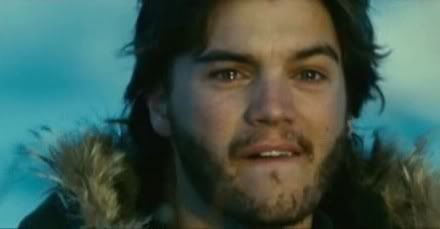
Into the Wild
Director: Sean Penn. Screenplay: Sean Penn, based on the book by Jon Krakauer. Cinematography: Eric Gautier. Film editing: Jay Lash Cassidy. Production design: Derek R. Hill. Music: Michael Brook, Kaki King, Eddie Vedder. Producers: Art Linson, Sean Penn, William Pohlad. With: Emile Hirsch, Marcia Gay Harden, William Hurt, Jena Malone, Catherine Keener, Hal Holbrook, Vince Vaughn, Kristen Stewart, Brian Dierker, Zach Galifianakis, Thure Lindhardt, Robin Mathews, Haley Ramm, Bryce Walters, Steven Wiig. USA. 140 min. 2007.
By David Sterritt
Sean Penn took on a real challenge when he decided to adapt Jon Krakauer’s eponymous book, which tells the true story of Christopher McCandless, a gifted and idealistic young man who finished college with flying colors, donated all of his savings to charity, and hit the road like a modern-day Jack Kerouac, hitchhiking from one short-term stopover and part-time job to another. Eventually he reached his final destination in Alaska, where he lived successfully off the land until a couple of unforeseen errors caused his death.
Penn‘s approach to this material is different from Krakauer’s in important ways. For starters, Krakauer reveals McCandless’s death at the get-go, while Penn saves it for the end, evidently hoping that suspense over the outcome will hook audiences more deeply into the tale. This is naïve; lots of people have read the book, and the paperback edition even puts the passage about McCandless’s demise on the cover. Yet it prefigures the conventional storytelling tactics of the picture as a whole, which replaces Krakauer’s clear-eyed pragmatism with high-key movie emotionalism.
Viewers unfamiliar with the film’s source won’t make such comparisons, of course, but they may be perplexed by some of the picture’s details. An example: McCandless is enough of a cultural rebel to give away one pile of cash and set fire to another when he enters the wild, but he’s not enough of a maverick to have sex with a sixteen-year-old girl who practically dragoons him into her bed. So is he a freethinking radical or not? This question is resolved in the book--to McCandless the girl was just another teenybopper, not interesting enough to be attractive--but in the movie it’s hastily and skimpily explained. (It doesn’t help that Tracy's played by a gorgeous actress who looks more like a movie star than a trailer-park waif.) More examples: Penn injects unneeded sentimentality into a sequence about McCandless’s friendship with an old man he’s met on the road, and he overuses a McCandless family secret as a raison d’être for the young adventurer’s restless, sometimes reckless personality. More broadly, Penn gives the film a flashback-heavy structure that mimics the book’s digressions into tangential subject areas (themselves an echo of McCandless’s digressive wanderings) without sustaining the intellectual momentum that makes Krakauer’s account so compelling. It’s possible to explain these decisions away—regarding the girl, for instance, McCandless may be manifesting the ascetic personality that took him to the wild in the first place—but Penn doesn’t deploy them cleverly enough to make them work as well as they need to.
I don’t normally push book-film comparisons this far; it’s a truism that adapting a book means exactly that, doing whatever’s necessary to make it speak in cinematic terms. But here the book is an extensively researched account that aspires to the lofty goal of journalistic truth, while the film is a highly subjective melodrama that aspires to the lower goal of psychologically plausible entertainment. Objectivity and subjectivity are relative qualities that exist more in theory than in practice, but the reduced impact of “Into the Wild” onscreen convinces me that Penn would have done better to sponsor a documentary that plugged directly into Krakauer’s chronicle, even if this meant dispensing with the remarkable portrayal of McCandless by Emile Hirsch, an actor of great promise. “Into the Wild” is a good movie based on material with far richer possibilities. And as a colleague said to me the other day, is Sean Penn really the guy to tell us burning money is a swell idea?

