
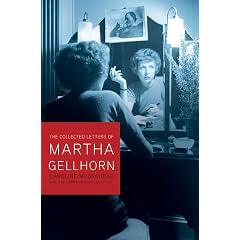
Next month, Holt is publishing Caroline Moorehead's The Collected Letters of Martha Gellhorn. It promises to be a lively complement to Moorehead's 2003 biography, Gellhorn: A Twentieth Century Life (also from Holt). Here's what Alexander C. Kafka wrote about that when it came out:
Readers might pick up Caroline Moorehead’s Gellhorn: A Twentieth-Century Life looking for action and heroism, and they won’t be disappointed. Gellhorn, a journalist, novelist, and short story writer, was astoundingly energetic, physically brave, curious, and an inveterate traveler who loved adventure and recounted it vividly. And Moorehead, whose mother was a good friend of Gellhorn’s and who previously wrote biographies of Bertrand Russell and Iris Origo, has plumbed letters, archives, and the memories of dozens of Gellhorn’s associates, surfacing with a balanced, lively rendering of an extraordinary life.
Readers taking up the book seeking Gellhorn the progressive, feminist icon shall also come away satisfied. The St. Louis daughter of a suffragette mother and a physician father dedicated to serving the poor, Gellhorn grew up steeped in liberal politics and the certainty that a woman could do anything. She saw her central purpose in life, and in writing, to be the exposure of injustice and cruelty. “The only way I can pay back for what fate and society have handed me,” she once wrote, “is to try, in minor totally useless ways, to make an angry sound against injustice.” She wrote some magazine fluff fiction at times to pay her bills. But it’s her accounts of the Depression, Spanish Civil War, World War II, Vietnam, and other conflicts and crises that so powerfully captured the plight of ordinary people caught in the brutal crossfire of clashing ideologies, or victimized by malfeasance and megalomania.
Some, no doubt, will savor the book’s wonderful gallery of celebrity sketches. Gellhorn was an intimate friend and confidante of Eleanor Roosevelt, H.G. Wells, Robert Capa, and Leonard Bernstein, to name a few. Even those who know little of Gellhorn’s career as a writer may know her as the third wife of Ernest Hemingway. And Moorehead depicts the heat, fire, smoke, and ashes that emanated from the coupling of those two emotional volcanoes.
What readers will probably not expect in Gellhorn is a stirring study of a deeply self-reliant, often depressive woman reckoning with aging, the gradual diminution of her professional abilities, a world that is leaving her behind, and a psychic battleground littered with the corpses of failed romances, friendships, and family responsibilities. A thoroughbred career woman decades ahead of her time, who also had the mixed fortune of being strikingly attractive, Gellhorn was a paradox, self-centeredly, sometimes savagely attempting to carve out for herself space to reflect the misfortunes of others. Emotionally wounded by the carnage of war—which she saw as “an endemic human disease, and governments are the carriers”—she felt deeply for people in the abstract, but often couldn’t abide them in the day to day.
And it is, strangely, this aspect of Gellhorn that is most resonant and successful. For all the myriad names, places, and events it gallops across, for all Gellhorn’s undeniable tough, Bacallish glamour, Moorehead’s book is, at heart, an existential study of a woman of action wrestling with the futility of action; a workaholic never satisfied with her work; a roamer who established homes in Italy, Cuba, Mexico, Africa, London, and Wales, but who didn’t feel at home anywhere for very long; a worshipper of human dignity unable to fully appreciate the merits and efforts of those who should have been closest to her.
Having left Bryn Mawr after her junior year, Gellhorn worked briefly as a cub reporter for the Albany Times Union, then went to Paris, where she had brief stints with the United Press and as a copywriter for an ad agency, and began a long-term affair, a quasi-marriage really, with Bertrand de Jouvenel, a married, French political writer. Gellhorn’s freelance journalism became increasingly serious and politically oriented as she covered, for instance, proceedings at the League of Nations and 1930s diplomatic maneuvers between the French and Germans. As her affair with de Jouvenel began to unravel, she ping-ponged back and forth between Europe and the States, taking on various travel, fashion, and other assignments, and maintained the kind of regular diary biographers must dream about.
For Harry Hopkins under Roosevelt’s Federal Emergency Relief Administration, she traveled America writing reports on the impact of the Depression, then drew on her experiences to write the book The Trouble I’ve Seen. Visiting Key West with her beloved mother, Edna (Gellhorn’s “true north,” she called her), Gellhorn met at Sloppy Joe’s bar “a large, dirty man in untidy somewhat soiled white shorts and shirt,” reading his mail—the 37-year-old, and married, Hemingway.
Their affair and eventual marriage was a tendentious stew of passion, writerly solidarity and competition, and ego and insecurity. They covered the Spanish Civil War together. As World War II loomed, they settled in Cuba, and vacationed in Sun Valley, Idaho, but soon she was back in Europe covering Finland’s defense against the Russians, while Hemingway and his chums drank too much and boated around Cuba ostensibly scouting for German subs. In China, Gellhorn and Hemingway traveled with the nationalist army, and met Chiang Kai-shek and Madame Chiang. They covered the allied assault on France, Hemingway exaggerating his exploits along the way, Gellhorn having to stow away on a hospital ship to get to the action at Normandy. By the time Paris was liberated, their marriage was devastated.
Gellhorn found in the boyish, and married, divisional commander General James Gavin a sensual mate and friend, and she assembled the novel The Wine of Astonishment from her latest war experiences, particularly seeing Dachau. Twenty-five years later, recalling her visit to the camp just after its liberation, she wrote, “It is as if I walked into Dachau and there fell over a cliff, and suffered a lifelong concussion, without recognising (sic) it. ... Looking back, I know I have never again felt that lovely, easy, lively hope in life which I knew before, not in life, not in our species, not in our future on earth.”
Undermined by their oversized personalities and inflexibility, the affair with Gavin ended. She moved to Cuernavaca, Mexico, and adopted an Italian war orphan, Allesandro, or, as she called him, Sandy. In love with a politically connected doctor in New York—who was married, of course—she became fiercely lonely, and moved to Rome, then to London to be with Tom Matthews, a widower and top editor at Time. They wed, and had a companionable, for a time, but ultimately loveless marriage that exacerbated difficulties between her and Sandy.
Taking lovers but swearing off marriage, she adopted Africa as her home for some time, but traveled frequently to, and kept up ties, in London and the States. In her late 50s, she went to Vietnam and determined, in Moorehead’s words, that “it was the Spanish civil war all over again, only this time she felt herself to be, for the first time in her life, on the wrong side,” America revealing a streak of what Gellhorn termed “natural fascism.” She also visited Israel often and befriended Moshe Dayan, but while she admired the young country’s verve and bravery, Gellhorn found the Israelis humorless. She spent her remaining years mostly in Africa and London, gradually surrounding herself with a smart set of young writers and journalists.
Gellhorn's journalistic legacy, though magnificent, is somewhat tainted by a few blind spots, Moorehead persuasively observes. Gellhorn’s writing about Africa has a condescendingly racist bent, and she had a rabid anti-Arab bias and was strangely dismissive of the Palestinian plight. For her, the lines between journalism and activism were always purposefully blurred (she decried “that objectivity shit”), and it’s clear that she and Hemingway vastly downplayed the atrocities they knew were being committed by the communists in Spain and by the nationalists in China.
But Gellhorn’s professional fortitude and commitment were nothing short of astounding. At the age of 85, practically blind in one eye, going deaf, and suffering from back pain and a nasty scrape on her arm from snorkeling, she went to Brazil to report for Granta on mysterious killings of slum children. What she wrote wasn’t up to par and never ran. With the frankness characteristic of her assessments of self and others, she wrote in a letter that it was “a journey too far. ... It is my last and worst article. ... The result is unsatisfactory to me in every way.” Who else could be counted on to try? And who else could so quickly recognize the failure? When she could no longer read, for a time she reviewed audio books.
She showed equal fortitude in her personal life, through unfulfilling love affairs, abortions, illness, car accidents in which her ribs were broken, the horrific death of a boy who ran in front of her car in Africa (she was, apparently, not at fault), and in her 80th year, rape on an African beach at Nyali, near Mombasa. “Women have been raped all over the world since time began,” she wrote in a letter a short while after. “Simply because I was involved does not make this case special. ... Fear is only damaging if you let it change your attitudes and actions, which certainly I shall not.”
Those exacting standards for herself could be quite poisonous when turned on others less strong, among them her adopted son. Her letters to and about Sandy make for painful reading. A fitness nut obsessed with her own weight, she harangued him about his weight problems, and even rewrote her will making his share of her estate dependent on his weight. Not the compulsive letter writer that she was, he infuriated her with periods of no contact, spells elongated by drug problems and a drug-related arrest. After one silence, she wrote him: “I have no respect for you, and at present little affection. ... You have absolutely no style, your mind is as interesting as blotting paper, you do nothing, you are unable to make anything of the days, the life, the places.” That she may have played a part in his troubles by her inability to sustain a marriage or settle in one place, by flying off to assignments while he was packed off to boarding school, seems not to have been a possibility she could face squarely. Self-medicating with the antidepressants Stelladex and Spansule Drinamyl, not to mention whiskey and cigarettes, averse to analysis or even family therapy for Sandy’s sake, she was evidently more insightful about the world than about her own life.
But in her late years, Moorehead suggests, Gellhorn went some way toward reconciling with Sandy, both of them realizing that her strenuous efforts to please her own father may have hindered her from being pleased by her adopted or stepchildren.
“Everyone grows old. Not everyone grows up. The object is to aim for that,” she wrote a friend.
As Moorehead chronicles with grace and precision, Gellhorn grew old, and up, both of them the hardest and best way she knew how. And when she committed suicide in 1998, it was on her own typically uncompromising, practical terms, leaving travel money for one friend, and silver knives and forks to another who’d recently had a burglary. She’d put labels on the furniture, put the trash outside the front door. Then, a jug of white tulips by her side, she put on an audio book, and, lost in someone else’s story, she took a pill.

