6/29/06

ASSETS: Will Your Golden Years Be Golden?


"I believe those people who own a portion of the economic machine are more likely to build their wealth, while those who choose to lend their money to banks in the forms of CDs, savings bonds and savings accounts, rarely achieve wealth."


By Doug Charney

Many of us start our careers believing we’ll retire as millionaires, but we do little to help make that belief a reality. That’s why a dangerous fantasy is not in disbelieving in the pot of gold, but in believing that somehow it will just appear when we need it through no effort on our parts. In fact, I believe we have two choices. We can work for that pot of gold through discipline and perseverance throughout our careers, or we can end up working part-time in our golden years just to survive.

I’ve seen many retirees have to work at least part-time. They believe when they retire that their $100,000 in savings means they have a lot of money, but they fail to see it’s not nearly enough to live on. Many people plan for their nest egg to run out at about age 65 to 70, when they feel they will not need it any longer. Actually, most people mispredict how long they will live. According to the Centers for Disease Control (CDC), the average man lives to be about 75 and women live to be about 80. (Health, United States 2005, Table 27, National Center for Health Statistics, Nov. 2005)

Here are eight steps designed to help you achieve financial independence so that when you retire, you may be able to find yourself asking, “Will you please pass the suntan lotion?” instead of “Would you like fries with that?”

1. Start now.


Of course, the earlier you start saving and investing for financial independence, the better, but it’s never too late to start. Commonly, people put off investing. They wait for the market to be right, believing that the secret to the market is timing. They look at the numbers and think, “Oh, the market’s too high to invest now.” Frequently, they procrastinate, not even going to an investment advisor when the market is low! In point of fact, a great instinct for timing the market will not necessarily lead to financial success. However, asset allocation and regular contributions to your 401(k), your IRA and your retirement plan will help you move closer to your retirement goals.

2. Choose a competent advisor.
Do you believe you only need an investment advisor if you have a big pile of money ready to invest? Do you think investment advisors generally charge too much? Don’t let these myths hold you back from starting to save and invest now. If you are just starting to invest, you may find it more economical to start with an investment advisor who is also starting out. Even new investment advisors have more training and knowledge than most investors--and can offer sound advice and information about relevant changes. Even with a modest income, I believe you need an investment advisor, an attorney and a CPA (one who does tax planning, not just your taxes) on your team in order to help you gain financial independence.

Choose your financial advisor carefully, interviewing several and looking for compatibility with you and your goals as well as integrity, accessibility and the ability to bring a variety of products to the table, not just one company’s. Once you have picked out an investment advisor, lay all your cards on the table and work together to develop a plan to achieve your financial goals.

3. Educate yourself.
Once you’ve found an investment advisor, you’ll want to learn as much as you can in order to supplement his or her advice. The better educated you are, the better you can work with your investment advisor, because you’ll better understand what he or she is trying to do for you. Improve your investment knowledge by attending as many advisor-sponsored seminars as you can. Read basic investment planning books, concentrating on them rather than articles in periodicals and newsletters. Books generally provide more depth than periodicals, in my view. As for the Internet, be careful in deciding whether to accept advice from people you don’t know. Surf the websites of well-known mutual fund companies, which often contain valuable articles and prospecti. Many investment firms also have websites that provide good information.

4. Pay yourself first.

Invest your money before you spend it. Treat your investment program as another necessity, along with food, shelter and transportation. When you sit down to pay bills, write the first check to your investment program. Or set up an automatic deposit system to put money from your checking account into your investment plan.

The old rule of allocating 10 percent of your income to investment still stands if you are starting to save early enough. If you are starting to save later in life, you will generally have to contribute a lot more than 10 percent in order to make up for years of not saving. Your best first investment should definitely be your employer’s retirement plan, which enables you to invest while receiving the advantages of tax deductions as your money grows, tax-deferred.

5. Choose your investments carefully.

Always be sure your investments match your objectives. If you’re seeking a long-term capital appreciation, then you may want to consider growth-oriented investments such as international and domestic mutual funds. (Investing in foreign securities presents certain unique risks not associated with domestic investments, such as currency fluctuation and political and economic changes. This may result in greater share price volatility.) If you’re retiring and seeking a monthly check from your investments, consider selecting those designed to produce income, such as balance funds (part stocks and part bonds) or bond funds.

In my view, slow and steady wins the game! Be consistent and stick with your program. Rather than chase after last year’s hot mutual fund, I believe you should look for those mutual funds that have a long-term consistent track record (although past performance is no guarantee of future results).

6. Spread your risks.

Working with your financial advisor, allocate your assets among several different mutual funds and different industries. This diversification of your investments can help to reduce the volatility of your portfolio. As you set it up, ideally, your portfolio will contain companies of all sizes, international and national companies, and bonds. (The prices of small- and mid-company stocks are generally more volatile than large company stocks. They often involve higher risks because smaller companies may lack the management expertise, financial resources, product diversification and competitive strengths to endure adverse economic conditions.) By not putting all your eggs in one basket, you are more likely to get a more consistent return on your investment. Moreover, international diversification can enable you to participate in an expanding world economy. Keep in mind that diversification cannot eliminate the risk of fluctuating prices and uncertain returns.

7. Be an owner, not a lender.
I believe those people who own a portion of the economic machine are more likely to build their wealth, while those who choose to lend their money to banks in the forms of CDs, savings bonds and savings accounts, rarely achieve wealth. To achieve financial independence, it may be prudent to take some risks, but don’t gamble with your investments. Achieve ownership through equity investments such as common stocks and mutual funds.

8. Avoid temptation.
If you’re investing for a long-term goal of financial independence, resist the temptation to spend your assets on short-term rewards such as big-ticket electronics or a new car. You lose considerably less when you buy a used car, for example. Taking money from your savings and putting it into something that depreciates as rapidly as a new car is counter-productive, in my view. If you receive a large distribution from a retirement plan because you change jobs, consider rolling it into an IRA immediately. Yielding to the temptation to spend some or all of the money can have an even more devastating effect on your long-term financial security than the taxes and penalties already imposed on premature distribution.

You don’t have to be a doctor, attorney or high wage-earner to achieve financial independence, pay for your child’s college education or even take an early retirement. People with moderate incomes and modest lifestyles often retire with enough money to support themselves during retirement. By following these eight steps and investing regularly and with discipline, I believe you’ll not only be able to potentially improve your financial situation, you may also become a financial role model for your children and future generations. I believe that if the rich really do get richer, it’s not because of opportunity so much as because each generation instills in the next the skills that it takes to make and save money.

Doug Charney is a senior vice president-investments with Wachovia Securities in Harrisburg, PA. For more information, he can be reached at: 1-888-529-2973.
Mutual funds are sold by prospectus. Please consider the investment objectives, risks, charges and expenses carefully before investing. The prospectus, which contains this and other information, can be obtained by calling your financial advisor. Read it carefully before your invest. The accuracy and completeness of this material are not guaranteed. The opinions expressed are those of the author and are not necessarily those of Wachovia Securities or its affiliates. The material is distributed solely for information purposes and is not a solicitation of an offer to buy any security or instrument or to participate in any trading strategy. Wachovia Securities, LLC, member New York Stock Exchange and SIPC, is a separate nonbank affiliate of Wachovia Corporation.
Modified photo. Original image from stock.xchng

URGE: The Allure of the Ex

"Before you have sex, are you willing to reestablish safe sex practices? Or are you in denial, certain that your partner has not been sleeping around since your breakup?"


By Dr. Trina E. Read

There you are sitting alone on a Saturday night, eating stale Doritos and watching old reruns of Seinfeld you have already seen seven times. It would not be so bad except you have an itch, a sexual itch that is, in need of scratching.

You start flipping through your brain’s Rolodex and realize that other than the slightly creepy person in accounting who flirts with you, there are no real prospects on the horizon. Big time Bridget Jones loser feelings start seeping into your every pore. Panic ensues.

Your mind wonders back to the sex you had with your last partner. Instead of remembering all the reasons you broke up, you start obsessing about their soft, warm body up against yours in your nice cozy bed.

Without thinking you pick up the phone. They answer. You try to make some small talk but it is of no use. You ask them to come over for a “drink.” Both of you know that is code for, “let’s have sex at least three times tonight.”

Your legs raw from twitching they finally arrive. In a mad rush to rip each other’s clothes off, there is little or no thought given to consequences. Your itch is about to be scratched…hopefully they will sleep over as an added bonus.

Sex with an ex. Good idea to keep your sexual juices flowing during the transition time? Or bad mistake that will keep you messed up for a longer period of time? As every breakup is different, doing some analysis might save you heartache when your libido takes over your brain.

First know you are not some freakoid because you want to have sex with the exact same person you spent days (maybe weeks) getting all bent out of shape over after the breakup. Sex can comfortably numb the I’m-a-big-fat-loser worries, pain and panic in the short term. It is convenient and semi-reliable.

As well, yours is an established relationship so all the preamble of getting to know each other and weirdness of seeing each other naked does not exist. Your ex is (hopefully) clean of any STD's. Also you might have gone through a lot together and on some level only they can understand you.

Now lets look at the other side of this equation. Never fool yourself. As much as you want to believe that sex is simply sex and nothing more, the act of sex is a ticking bomb of many emotions waiting to go off.

To start with, count the time elapsed since your separation. The fresher the breakup, the stronger both your favorable and angry emotions for this person will be. Conversely, the longer time your relationship has been over and done with, the better chance those dormant emotions will be jolted back to life.

Be clear in this confused moment: The need for sex can be a clever cover for needing an emotional reconnection with another human being.

If the sex is good (i.e. deep emotional connection), you may wonder why you broke up in the first place. Due to these confused emotions, it is easy to start playing the “come here/go away” game, and moving on may take a lot longer than necessary.

Next is being OK with the hardcore reality of your situation. Before you have sex, are you willing to reestablish safe sex practices? Or are you in denial, certain that your partner has not been sleeping around since your breakup.

Are you ready, in the aftermath of your sex, for your ex to start exhibiting the traits that had you breaking up with them in the first place? Know you will most likely feel empty and unfulfilled because after they leave you will again be partnerless.

What if they never call you back and, shamefaced, you realize you were simply their booty call for the evening? Speaking of which, are you mentally prepared for the eventuality of your ex telling you they have moved on to their next partner?

If you are all right with all of that then go ahead have tons of protected sex with your ex. If not, take a long cold shower or slap on a chastity belt when you feel your resolve wearing thin. Do whatever it takes to stop yourself from calling them.

One great thing that comes out of having sex with an ex is the valuable lesson learned. Ultimately satisfying an urge at the sacrifice of self worth is never worth it—yes, even if the sex is amazing.

Samantha Jones, the infamous character from Sex and the City put it best: “Sex with an ex can be depressing. If it's good you can't get it anymore, if it's bad you just had sex with an ex.”


Common-sense sex expert Dr. Trina E. Read is a columnist and international speaker. See http://www.trinaread.com/, or contact drtrina@trinaread.com.


Photo from stock.xchng

CAREER: Leading Pain-Free, Productive Meetings


"To keep difficult people from derailing your meeting, intervene in advance. Speak with them one-on-one so that they can vent or discuss what’s on their minds outside of the meeting context."


By Suzanne Bates

Do you think all meetings are painful, time wasting, poorly run and unproductive torture sessions? If you hate meetings, you’re not alone. Practically everyone does, and although businesses have to run meetings, very often, meetings run businesses. More than just a drag, bad meetings can have a tremendous negative impact on productivity and the bottom line.

You may think that the only thing worse than sitting through meetings is having to lead them. After all, you don’t want all that wrath and boredom directed at you, right? Rather than dreading running meetings, though, you can embrace the opportunity to polish up and show off your leadership skills. The style in which you lead a meeting will establish its tone and influence the meeting culture. People will take their cues from you, adopting your good practices.

Different types of meetings require different approaches. You must be flexible and adapt to the purpose and participants in a meeting. While there are different meeting styles, some practices and policies make all meetings better. The following five steps will enable you to lead great meetings:

1. Determine purpose and prepare for productivity

As the meeting leader, you must determine why the meeting is taking place in order to know who to invite, what to put on the agenda, how long to discuss each item and even what methods to use to come to a decision. Productive meetings begin with good pre-meeting communication. Several days or even weeks in advance of the meeting, call, e-mail or speak in person with influential people. Identify which issues will need to be addressed. This checking-in process will help you to deal with objections and build consensus.

2. Write an agenda and stick to it

Without an agenda, participants cannot prepare, so time is lost while people read or catch up. Missions fall by the wayside as people talk about whatever is on their minds instead. As the meeting wanders, some may start up whispering side conversations and anyone dominant enough can easily hijack the meeting. Agenda-less meetings often must end before decisions are made, or decisions are made after key people have to leave. Sound familiar?

Realize that you can’t solve all the problems of the world in one meeting. If you decide to spend 10 minutes on something, and the 10 minutes is up, it’s your responsibility to move on. You may be amazed to find what a difference just starting and ending the meeting on time and keeping it clipping along will make in participants’ morale and willingness to participate now and in future meetings.

3. Encourage discussion and participation

Your most valuable resource is the collective knowledge of others in the organization. A good leader encourages participation in order to harness others’ creative power. Everyone will benefit when you make the atmosphere safe and easy for everyone—even the shy ones—to get involved.

Take note of those who remain silent, and make it a point to ask them what they think. You don’t want those who disagree with you or with the group’s decisions to not say anything, and then leave the meeting and attempt to undermine the decisions later.

Encourage participation by saying:

· “Stan, you shook your head just now. What else do we need to consider?”
· “I would like to hear from Amanda on this.”
· “Jack, you and I talked about something before the meeting. Would you share it?”
· “Do we have all the issues on the table?

4. Listen actively

Listening well and being able to provide a brief but accurate review of what has been said sets great leaders apart from the rest. To summarize effectively, you must hear everything that is said, and even more important, notice what is not said. Take notes or listen in “note-taking” mindset to key words and phrases. Put ideas you hear into the context of the whole discussion, and you will find that this creates accountability. Ask questions and then truly listen to the answers.

Questions that will yield valuable insights might begin with:

· “What’s your reaction to…?”
· “What’s your view on…?”
· “What led you to…?”
· “How could we…?”

5. Manage conflict and deal with difficult people

As a meeting leader, if you ask good questions and make it safe to disagree, participants will debate issues on the merits. You can’t allow discussions to get personal or let issues go unresolved; otherwise, you risk damage to the whole organization, not just the individuals involved. Meeting leaders must promote positive conflict while avoiding personal attacks.

While debate is usually healthy for organizations, some people in the group will test the limits. Because they are angry or feel ignored, they will argue miniscule points, be unable to see others’ views, or fail to recognize the value of compromise. They may be poor listeners or have hidden agendas. Most of the time, difficult people are unaware of how they affect others, or what a serious impact they have on their own careers as well as on the effectiveness of their teams.

To keep difficult people from derailing your meeting, intervene in advance. Speak with them one-on-one so that they can vent or discuss what’s on their minds outside of the meeting context. During the meeting, allow them to have their say, and even ask a few questions, and then move on. Remember, your role as a leader is to enforce time limits.

Learning meetings skills leads to great opportunities

Good meeting leadership is not as common as it should be. Few people have the skills, and even fewer are taught how to lead meetings effectively. Rather, like most of us, they sit through many bad meetings, develop a lot of terrible habits, and then, when it’s their turn to step up and lead, they just don’t have the skills to do it.

Your ability to run meetings well is a direct reflection of your leadership skills. Your staff, your peers, and the people you report to will all judge how you lead meetings and, in turn, whether your meetings accomplish results. In other words, your leadership skills will have a direct impact on the organization’s bottom line because the meeting is not an end in itself; it is a vehicle to accomplish the work of the organization. By following these five steps, you can learn how to lead productive, pain-free meetings, demonstrate that you have these leadership qualities, and position yourself for promotions and advancement in your organization.

Suzanne Bates is president and CEO of Bates Communications and author of “Speak Like a CEO: Secrets to Commanding Attention and Getting Results.” See http://www.bates-communications.com/ or call 800-908-8239.

Photo from stock.xchng


6/28/06

ESSAY: Independence Day


"Holding that warm, slim hand in mine, I sensed for the first time that I was someone other than who I’d been."


By Alexander C. Kafka

I’m sure that Independence Day has personal, metaphorical connotations for many people. Who can help but equate some private liberation with the patriotic kind, especially since the latter happens to fall—for kids, anyway—during summer vacation, when liberations flourish? For me, the day resonates with the splendidly helpless plummet into first serious love.


I was in the Young Artists Piano Program of the Tanglewood Institute, the famed summer music school in the Berkshires. There were less than a dozen of us studying with a clever and somewhat eccentric teacher, Gyorgi, and his considerably younger, soft-spoken, muscle-bound assistant Chris, a dancer-turned-pianist whom we all assumed was Gyorgi’s lover. (No, not their real names. None here are, except for Mike Udwin’s and Mayer Fishman’s, but let’s not get ahead of ourselves.) Gyorgi and Chris were wonderfully innovative—though at the time we were more likely to use the word “nuts.” They had us learn, among other assignments, pieces from an album called The Waltz Project, made up of new waltzes by contemporary composers like John Cage and Robert Moran and Joan Tower.

The YAPP pianists shared a campus—an old mansion and a bunch of teepee-shaped cabins—with some orchestral students, mostly wind and brass players, and miscellaneous other instrumentalists, like Lou, a college-age classical guitarist who bunked with me. Indian Hill, as it was called, was a short walk from Stockbridge and a bus ride away from the concert campus where the Boston Symphony, chamber groups, and other fabulous musicians—professional or would-be—rehearsed in the hot days and performed in the cool nights. The other instrumentalists were housed at another former school, near Lenox and the concert halls.

Truth to tell, I felt a bit over my head at YAPP. I was musical, had studied piano for some 11 years, had a knack for improvising and an above-average ear. But I was also somewhat lazy about practicing and, as a sight-reader, lousy to the point where, in retrospect, I suspect I had a kind of music-score dyslexia. I obscured that by memorizing fairly long and difficult works quite quickly, Chopin’s Ballade No. 3 in A-flat and Debussy’s Suite Bergamasque chief among them. Technically, I was decent, but a little behind my YAPP peers.

It was the summer before my senior year of high school, and it’s difficult to describe how free and sensuous and exhilarating and nerve-wracking Tanglewood was. Students were assumed to have adult self-discipline to match their advanced aesthetic sensibilities. To this day, I recall entering the campus driveway in the van from Pittsfield airport and seeing a gorgeous blonde girl in cutoffs and a bikini top, perched on a boulder and practicing the French horn. That appealed to the Wagnerian degenerate in me. But the summer, on the whole, was more redolent of Rousseau—especially because I’d spent the prior two summers at Interlochen, in Michigan, which you might call the West Point of arts programs.

Interlochen students wore uniforms (including absurd knicker-style pants with knee socks for the girls) and suffered such indignities as Date Gate and Shake Gate, where after concerts boys kissed their dates or shook their hands, under stallag-like supervision, before heading back en masse to a separate campus. Interlochen had lights-out and trumpet reveille and morning calisthenics.

At Tanglewood, for pianists anyway, there were lessons and master classes, but mostly there was solitary practice, in hot, small bug-ridden wooden sheds that the uninformed might easily have mistaken for outhouses. We were pretty much left to our own devices, and whatever rules may have been on the books, coed night visits to other bunks, or languorous walks to Stockbridge beneath tall, shady trees, were treated as casually as at a college campus.


II.

The majority of the YAPP students were Asian-American girls, and among them was Mia, a 16-year-old from Annandale, Virginia, just a short Beltway ride away from my home in Bethesda, Maryland. She was talented and serious about piano, but not in the mirthless tunnel-visioned way that some students were. She was slender and athletic, with long hair and preppy clothes. She had a quiet seriousness about her that, to me, represented both an exotic distance and a tidy wholesomeness, both of which I longed not only to be near, but to embody. I was, in fact, under something of an Asian spell that summer. My most heartfelt fantasy was to be transmogrified into Seiji Ozawa, wear white pajama suits while commanding a first-rate symphony with the sweep of my baton, and be surrounded at fund-raising soirees by tan, post-hippyish looking, monied babes with bell-like laughs. I wanted to sport Seiji’s humble, Cheshire-cat smile, the kind you can only get away with if you happen to be significantly better than everyone else on earth at what you do.

I was instead a modestly talented, insecure Jewish kid from a tight-knit, talkative, analytical family in the burbs. I had thickish aviator glasses, perpetually donned an over-stretched blue and white warm-up jacket I’d gotten as a bar-mitzvah gift several years before (the matching pants were too long and ungainly even for me), and I had no idea what I wanted to do with my life. I did know, though, that I enjoyed the small circle of friendship and commonality with my YAPP friends, and that watching Mia, as I did none-too-subtly, I’m sure, I could at least take in some of what I couldn’t become.

The YAPP group became pretty close-knit in a short time, and Mia warmed to me, too. She laughed at my sophomoric riff on Mahler. We had read that he was superstitious about anyone being able to compose more than Beethoven’s nine symphonies. So I elaborated that he went on to write symphonies 9a, 9b, 9c, and 9d. Reading about Alma Mahler, as we munched on chocolate chip cookies on the lawn outside the amphitheater, we had a nice, puerile chortle over what it would be like to go out with a guy named Gropius. We walked by the sprinklers and through the lovely maze of hedges.

After dinner, the YAPPers would hang out on blankets at dusk on the Tanglewood lawn outside the huge Shed amphitheater drinking hot chocolate and listening to Mozart or Beethoven or Mahler. We couldn’t even see Ozawa and the symphony from where we were, but we’d look up at the dusk sky and see the musical cliffs and oceans and fire and plains that the orchestra created, then trekked through, in the brisk Berkshire ether.

On Independence Day, not too long into the YAPP season, Leonard Bernstein conducted a fun night of warhorses, culminating in the 1812 Overture and fireworks. It began to rain as we navigated through the exiting mob of tourists to the old school bus that served as our shuttle back to Indian Hill. The other students were in a rowdy, talkative mood after the celebrity and the cacophony and the crowds, but Mia and I, she in a tasteful pale green slicker, me in an awkward Super Surplus poncho, sat toward the rear of the bus, quiet, slouched, holding hands. I was happy beyond precedent. Holding that warm, slim hand in mine, I sensed for the first time that I was someone other than my heroes, other than what I coveted, other than who I’d been. I had not the faintest idea who this new guy was, but that didn’t matter as long as he was with Mia.

When we left the bus, Mia and I stood, paralyzed by lust and inexperience, in the rain on a corner of the lawn in front of the old school building, kissing long and deep. Every now and then, my mouth would make its way to her spicy, lean, wet neck and back to her mouth again, like a pony, restive and corralled. Occasionally, we’d stop and just catch our breath and murmur to each other. Our hands reached each other’s waists and backs, then bottoms through our jeans. The rain eased up, and we shivered in the leaf-sparkly damp, barely illuminated by a few dim security and street lights, stuck and thrilled. I tentatively reached a few fingers down her pants. She gently took my hand away and kissed me harder. Two things were clear. (1) We’d do nothing encroaching too near the domain called sex, and (2) I was her boyfriend.

Eventually, exhausted and frustrated and dazzled, we said goodnight. When I got back to my teepee, I fell onto my bed next to a shelf lined with music books along with Portrait of the Artist as a Young Man, Sons and Lovers, and the other novels on my summer English reading list. Lou was quietly strumming Villa-Lobos ballads as I drifted off.


III.

Mia and I didn’t overdo the couple stuff when we were with the other YAPPers, at concerts, or heading down to Stockbridge for Cokes and potato skins at Michael’s restaurant. But when we were alone—say, sweaty after tennis at some courts down the road from Indian Hill­—we made out with the Olympic intensity that comes from knowing that this was the love sport we’d have that summer, that there would be no other. Well, almost no other. After a week or so, she’d allow me to grope around her panty line beneath the diminutive terry-cloth shorts she wore for tennis. And at night— when we returned from a vocal recital or chamber concert­­—I’d unbutton her blouse and she’d lie back on the steps of one of the practice sheds and let me undo her silk bra and kiss her small breasts. Once, her hand grazed the tip of me, but retreated in an instant.

I knew the names of her family members, that difficult subjects came easily to her in school, that she was dubious about our teacher’s obsession with contemporary waltzes. I knew that she took Catholicism seriously and I went to a pretty little church with her in Stockbridge and even played a Bach prelude and fugue on the organ toward the end of a service, though Mia dissuaded me, in my amative enthusiasm, from taking the Eucharist.

In other words, I knew her hardly at all, but I loved her—far beyond a crush, and with some inkling that what we had would not survive the shift to distance, small though it was, and the mundane of the school year. I knew boys—handsome, strong, accomplished, promising, confident boys—would surge around her. I knew girls—lovely, graceful, talented, sympathetic girls—would not even notice me, except perhaps in a hallway to give me a submission to the school literary magazine I co-edited. I knew lunches would not be spent in a quiet dining hall earnestly debating the best wrist action for playing Ravel’s Miroirs, but rather in a horrifyingly loud cafeteria trying to figure out, with Michael Udwin and Mayer Fishman, a calculus problem or what our back-up schools would be or what actually occurred at screenings of The Rocky Horror Picture Show.

I saw Mia once more, for a date. I drove to Annandale, and we went to see An American Werewolf in London at a mall. The movie was scary and funny and sexy, but we were oddly somber, awkward. We kissed in the parking lot before I drove her home in my mom’s Granada, but something had changed. For Mia’s 17th birthday, I wrote her a poem, which five years later I foolishly threw away along with all my childhood poems. I remember only one line: “When you are near/love is not a complex thing.” But though I didn’t realize it then, the line was already nostalgia, and I never heard back from her. I sensed a rival whom I couldn’t rival. I was too hurt to pursue it. And I had other things to think about, most immediately the removal of four wisdom teeth, tryouts for The Music Man, and a dozen college application essays.

I went back to Tanglewood the next summer, as much out of habit as anything else. It was my sixth year of music camp. I was searching, I suppose, not for Mia—I’d heard she wouldn’t be there and was headed for Barnard in the fall—but for some equivalent intensity, warmth and bliss. Predictably, I found none. The YAPPers were on the Lenox campus this time around, and that was much less suited to pastoral daydreams and passion. One night, in the bland, slightly decrepit room I shared with two roommates, a window fell open on its chain above me, the glass shattering onto my blanket. I wasn’t hurt, but the incident seemed somehow telling.

The pianists were under the no-nonsense, traditional stewardship of another instructor. I practiced a great deal, not having the distractions I would have preferred, but my heart wasn’t in it. In my free time, I’d go to the Lenox library and read the Times and novels. From a friend, I borrowed a Walkman, the first I’d ever seen, and went on long strolls or jogs listening to Brahms, music that suited the lush, rolling hills and my melancholy mood.

At college that fall, I gleefully quit the piano to take up acting and ski team, which were considerably more social and fun. A year after that, I briefly dated a woman, Helen, who’d been in the YAPP program with me both those years at Tanglewood. A year younger than me, Helen had been the most musically and academically gifted of our YAPP cohort and she was the only one among us we could imagine successfully pursuing a concert career. She was very bright, in a sharp and brittle way, but also deeply sensitive. When she played piano, particularly Brahms, the interpretations were eerily wise and sad, as though there were a melancholy middle-aged virtuoso lurking inside her.

When we started seeing each other, she treated me badly—she was always late for dates, and around other people she’d practically ignore me, as if to show that couplehood would in no way dissuade her from being her own person. I think she was a little afraid of the intimacy, but also wished she were with someone who could confirm her sophistication (I didn’t fit that bill). And this was college, after all—she may have slighted me just to see if I’d put up with it. Surprisingly, I was sensible enough not to. I broke up with her after an evening of heavy petting and heavier sarcasm. I had a jar of pennies. She picked it up and hurled the pennies at me­—though, fortunately, not the jar—and stormed out of my dorm room. In my underwear, picking up the coins, one by one, listening to the Goldberg Variations on my battered pawn shop turntable, I realized the obvious—that whatever Helen had been seeking, I’d been seeking Mia.

Twenty-five years later, I’m married to a woman whom I adore and who prefers Nanci Griffith to Hindemith. We have delightful eight-year-old boy-and-girl twins who enjoy soccer, reading Cam Jansen and Jigsaw Jones mysteries, and putting on shows in our family room. Life is fabulously full, and I am fully aware how lucky I am, even if I’m not Seiji Ozawa, who I suppose by now is reckoning with his own memories of Tanglewood.

But for an instant every Independence Day—especially if it’s a rainy, breezy one with restless trees—I think of 1981, and of Mia. For me, that day, that summer, was a taste of pleasures to come and a person to become rather than trying to be. And each Independence Day I hope Mia feels that same slight stir, wherever she is.

And if she doesn’t, I don’t want to know.


An excerpt from this essay ran in
The Washington Post.


Modified photo. Original from stock.xchng.

6/24/06

PHOTOGRAPHY: Henry Horenstein

Henry Horenstein has worked as a photographer, teacher, and author since the early 1970s. He lives in Boston and teaches at the Rhode Island School of Design. These are from the his 2003 book Honky Tonk: Portraits of Country Music 1972-1981.


~Fiddler Tater Tate, Gettysburg Bluegrass Festival, Gettysburg, Pennsylvania, 1974. ~Carol Lee Cooper backstage, Grand Ole Opry, Nashville, Tennessee, 1974. ~Patrons at a honky tonk, Lafayette, Louisiana, 1977. ~Lovers, Tootsies Orchid Lounge, Nashville, Tennessee, 1974. ~Ramona and Grandpa Jones, Grand Ole Opry, Nashville, Tennessee, 1974.


6/21/06

POEMS: Chris Tusa

Chris Tusa is an English instructor at Louisa State University. These are from his collection Haunted Bones.


Hypochondriac

Maybe it’s Emphysema, a shiny black jewel of phlegm
humming like a clump of bees in my chest.
Perhaps a tumor crawling in the crook of my armpit,
a blood clot opening like a tiny red flower in my brain.

Maybe it’s too early to show up on an X-ray,
a kind of cancerous seed planted deep
in my intestine, something like Leukemia’s ghost
haunting my hollow bones.

The doctor says I’m fine.

But even now, deep in the dark holes of my eyes
I can feel the cataracts spinning their silver webs.
Even now, in the bony cage of my lungs
I can feel the heart attack’s prologue,
the opening words of some prolific pain
like a bird stabbing its incessant beak
into the ripe red meat of my heart.


Ode to Gumbo
after Sue Owen

Born from flour anointed with oil,
from a roux dark and mean as a horse’s breath,
you remind me of some strange, mystical stew
spawned from a muddy version of Macbeth.
Only someone’s replaced the spells with spices,
the witches with a Cajun chef.

Maybe you’re a recipe torn from Satan’s Cookbook,
a kind of dumb-downed devil’s brew
where evil stirs its wicked spoon
in a swampy sacrificial hue.
Maybe God damned the okra that thickens
your soup, the muddy bones that haunt your stew.

Maybe this is why, when we smell the cayenne,
we’re struck dumb as a moth.
Maybe this is why everything that crawls or flies
seems to find its way into your swampy broth.


A Retired Voodoo Priestess Dreams of Revenge
from The Psych Ward in Charity Hospital


Only three days and already I loathe this place,
this milk-white morgue, this smiling slaughterhouse,
where girls in straitjackets grow fat on pills,
floating on pale clouds of Clozapine,
sad white angels with their wings lopped off,
their eyes blind as stones rattling in a gris gris bag.

I’ve had it with these nurses, with their dull
white smocks and their hypodermic needles,
the smiling orderlies with black holes for eyes,
their veins pumped fat with steroids,
psychiatrists with the same filthy grins,
talking through their pink Pepto-Bismol mouths.

Do they know that with one pinch of cayenne
I could turn their liver into a hornet’s nest,
make roaches scurry through their black veins?
That with one single strand of horse’s hair
I could squeeze the breath from their fat pink necks,
stop the clock from ticking in their chest?

Do they see me in the cold dull afternoon
sewing bloodroot into dolls, drawing X’s in the air?
Do they know that while I stand in line for meds
I'm working a mean batch of spells in my head?
That at night I keep a crow’s foot in my pocket,
hidden like a white pill under my tongue?


Snow White, to the Prince
after Susan Thomas

Truth is, my life was no fairytale,
that afternoon, I lay, a smiling corpse
under a glass sky, a rotten apple
lodged in my throat like a black lump
of cancer, your sloppy kiss dying on my lips.

Did you really believe a kiss could cure
the poison galloping through my veins,
as you stood there, with your ugly white horse,
the voices of dwarfs buzzing like flies
in the apple-scented air?

I wish you could see me now,
how I take to the sky, a witch
without a broom, an empty black silhouette
with stars for teeth, spooking deer
into briar patches, swallowing the shadows of trees.

I wish I could slip into my beautiful white flesh,
just once, my pretty white feet stuffed into black slippers,
my poisoned-breath fogging up the smiling mirror.
If only you could see the light pouring from my skin.
If only you could hear the songs my bones sing.


Fear of Weather

Once a favorite conversation piece,
now something more like a disease.

A weathervane sings, a wind chime clangs.
It’s December, only a slight silver breeze,

but already I’m imagining the tangled
metal of cars, birds falling from the trees.

My therapist says fear is normal,
that it’s simply a matter of degrees,

the brain has an internal mechanism,
she says, a switch that flicks on and off with ease.

I imagine a kind of silver machine
in my brain, humming like a hive of bees,

fear hopping from synapse to synapse
like some sort of electric, Post-modern flea.

Each day I swallow my grief like a pill,
ignore my therapist’s advice, my wife’s pleas.

I wait for the sky to fall, longing for the days
when wind was only wind, trees only trees.


Kindergarten Portrait of My Mother at Mardi Gras

She looks rather pathetic, really,
leaning against the black air,
the three mangled fingers of her left hand
clutching a yellow purse,
her right arm raised over her head
as if to shield herself
from the silver shower of stars
raining down upon her.

Her mouth is a crack
growing beneath her nose.
Two dimples open like holes
in her cheeks. A pink ear
dangles from her chin.

Looking at it now, it's clear.
But who could have possibly know then
the dark shades of meaning
lurking in the shadow of her face,
the quiet relevance of the pearl necklace
swimming around her neck,
the orange birds drifting above her
like question marks?

Or that twenty years later
it would all make sense-
the way her eyes roll toward the sky,
the way my father stands behind her
in the crowd, arms waving
in the wind, as if he's slowly drowning
in the black sea of faces.
Am I Blue?

By Alexander C. Kafka

Our son Julian was blue, and he couldn’t have been happier about it. Almost 3, he was passionate about color—not colors, mind you, but color. One color. Blue.

My wife and I were prepared for the boys-prefer-blue ethos. And it’s not that Julian was particularly macho. He got jealous of his twin sister Adrienne’s barrettes and would have loved a couple of his own, and he could push doll babies in strollers around his preschool classroom with the best of them. But he adored blue, with the intensity of religious fanaticism, political credo, and aesthetic manifesto all rolled up in one. The degree of his commitment to the hue was reflected in his pronunciation—a sensual, insatiable, delightful “buh-LUE.”

He didn’t just like to wear blue, he gravitated to everything blue. He spotted my Cool Blue Raspberry Gatorade one day and started asking regularly for “blue juice.” Because we wanted him to drink more milk than juice, I always told him that there was no blue juice open. Then when I asked him later if I could get him anything at the grocery store, he said he wanted “blue juice that opens.” Reforming the system from within.

He turned on the TV and clicked through the real channels to the blue default screen on a channel we didn’t get. Listening blissfully to the static and staring into the deep blue, he purred, “This is my favorite movie.”

When he finger-painted, he did so in blue. When he drew with crayons, he did so in blue. When he used sidewalk chalk, it was the blue one. The family was strolling one day, my wife Lauren and I were chatting, Adrienne was singing “A, B, C’s” and Julian stared upward, transfixed, at the clear sky. “Mommy, daddy, pahdon me!” he bellowed (we had taught them to say “pardon me” if they interrupted, but hadn’t conveyed that it was best done quietly). “Yes, Julian, what is it, honey?” I said. “The sky is buh-LUE?” he wished, in wonderment, to confirm. “Yes, it is.” He stared up, longingly, having discovered his place of origin.

Blue had such power for Julian that it was not just a color. It was an honorific. After his hernia surgery at Children’s, his first request in the recovery unit was for blue crackers, so hungry was he. He might have meant his favorite brand of saltines, which came in a blue box. Then again, he might really have meant blue crackers. With Julian, you never knew.

He referred to his two constant companions as his “blue people.” A stickler might note that the blue people were neither blue—they were black and white—nor were they people—they were a cow and a dog. What was clear was that Julian regarded them as his dearest companions and most vulnerable charges. If we tucked him in for naptime or night-night and failed to cover his blue people properly with the blanket, he protested, with the somber indignation of a paternalistic Latin American dictator, “I am cozy, but my people are not cozy.”

That which was good was blue. That which he wanted most was blue. It must have been, for why else would he want it? Thus a cozy fleece jacket was his “little blue jacket”; never mind that it was gray.

I know what you’re thinking: The boy simply didn’t know his colors. But he did, as long as they were in a book divorced of all daily associations. But in this three-dimensional world, blue was a status, a recommendation, an authority.

His yummy Flintstones chewables were blue—or else. “Is it blue, mommy?” he’d ask, holding a vitamin. “Actually, it’s orange.” “It IS blue!” he’d protest, verging on a tantrum. This was a ritual repeated daily.

Finally we arrived at the concept of “honorary blue” to describe that which should be blue and yet, due to some anomaly in the structure of the universe, does not appear so. Thus, we could say of favored vitamins, clothes, balls, skies, cars, and even some relatives, that they were, for example, “green, but honorary blue,” a determination Julian accepted with grudging equanimity, like a white-collar criminal learning of a fairly favorable settlement offer.

In such improvisatory ways, we weathered his stormy mood indigo.

6/20/06

WALKABOUT: Shopping in Shanghai

"I was standing in my underwear in a supermarket in Shanghai in front of 30 or so strangers. Walkie-talkies were buzzing. I tried to act nonchalant."


By Stephen T. Asma

I went to a large Chinese supermarket to buy a watch because my fine Walgreens timepiece had finally given up the ghost. The store was an enormous hangar-sized structure with produce on the first floor and household goods on the second.

China is more accustomed to street-side markets, not centralized bureaucratic shopping. For example, when I found the watch I liked, the nearby saleswoman was not authorized to help me so she ran to get someone else. He arrived with a walkie-talkie and seemed like he would get things done. I pointed out the watch. He nodded and reported into his walkie-talkie, then turned to me and said "deng yi huar" (wait one moment).

Finally an even more official looking fellow arrived wearing a tie. He took careful note of the watch's position in the case, spoke into his walkie-talkie, and said "deng yi huar." Eventually an old woman appeared way in the distance carrying a large chain of keys. The two management guys started shouting at her "quai, quai" (hurry-up, faster). After I had secured my watch, I experienced a similar flocking of workers and managers all trying to remove the non-theft magnetic sensor from it ­so that I could pass through the exit sensor field.

As I passed through the airport-style security exit, I set off the alarm. A young man in a pressed white shirt and, of course, carrying a walkie-talkie stopped me and examined my bag. I showed him the receipt. Everything seemed in order. A team of security guards and bored bystanders meandered over with mild interest. Would I please go through again while security held onto the bag? Again the alarm.

I emptied my pockets and tried once more. A large crowd started to form around me. Everyone in the crowd seemed amused, some chuckling, ­and I retained my humor though, at this point, I was standing shoeless with all my pockets emptied and even pulled out of my pants to demonstrate my innocence. Managers were showing up now and asking me to rehearse the same parade through the security gates. Each higher-up had to witness the whole incident again from the start. I dutifully accompanied every alarm with varying facial expressions of bewilderment. The only English the guards seemed to know was "sorry" and they looked sincere. I don't think it ever occurred to them to pass me through. It was not in their power to make such a decision.

So, we just kept waiting for higher and higher level management to arrive. Ten or 15 minutes had passed and I was still setting off the alarm, wearing only a T-shirt and a pair of pants. About 30 people had gathered to watch the troublesome guelao (foreigner, literally "white ghost"). An old man seemed to be telling the main guard that I had nothing on me, ­isn't it obvious? I couldn't really see any resolution to the scenario. I invited them to search me and pat me down, which they tactfully refrained from doing, but they clearly had no intention of letting me go either.

The sideshow just kept getting bigger. Finally I shook my head and removed my shirt. Management looked embarrassed. Spectators smiled, laughed, studied my tattoo, and gave me an approving thumbs up.

Next went the pants. I was standing in my underwear in a supermarket in Shanghai in front of 30 or so strangers. Walkie-talkies were buzzing. I tried to act nonchalant. I walked through the gates, and finally the alarm was silent. The culprit was some mysterious manufacturer's tag inside my pants, and after a cursory search of the offending trousers by a mortified manager, I was allowed to leave.

The crowd was thoroughly amused. I felt something like amusement mixed with humiliation. It was not a new sensation.


Stephen T. Asma is a professor in the department of liberal education at Columbia College in Chicago. His books include The Gods Drink Whiskey: Philosophical Dispatches From the Tattered Land of the Buddha.

Photo from stock.xchng, and modified.

6/19/06

ART: Ellen Winkler


Ward Place, in monotype and oil paint.

Ellen Winkler is a graphic designer, printmaker,
and painter in the Washington, D.C. area.

6/16/06

The Yoga Novice's Lament

I'm a stinka at astanga
and can't hold this pose much longa.
From lunch I feel some bloat
when I try to do the boat.


Ode to Id

There are days one must just get through,
though some poets disagree,
and times that are not meant to be enjoyed.
There is news to be perused,
not passionate, not confused,
and thoughts that one is better to avoid.


-A.C.K.

6/15/06

SHELF LIFE: Martha Gellhorn


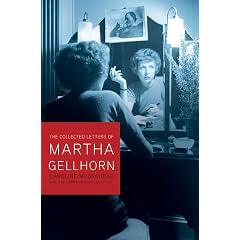
Next month, Holt is publishing Caroline Moorehead's
The Collected Letters of Martha Gellhorn. It promises to be a lively complement to Moorehead's 2003 biography, Gellhorn: A Twentieth Century Life (also from Holt). Here's what Alexander C. Kafka wrote about that when it came out:

Readers might pick up Caroline Moorehead’s Gellhorn: A Twentieth-Century Life looking for action and heroism, and they won’t be disappointed. Gellhorn, a journalist, novelist, and short story writer, was astoundingly energetic, physically brave, curious, and an inveterate traveler who loved adventure and recounted it vividly. And Moorehead, whose mother was a good friend of Gellhorn’s and who previously wrote biographies of Bertrand Russell and Iris Origo, has plumbed letters, archives, and the memories of dozens of Gellhorn’s associates, surfacing with a balanced, lively rendering of an extraordinary life.

Readers taking up the book seeking Gellhorn the progressive, feminist icon shall also come away satisfied. The St. Louis daughter of a suffragette mother and a physician father dedicated to serving the poor, Gellhorn grew up steeped in liberal politics and the certainty that a woman could do anything. She saw her central purpose in life, and in writing, to be the exposure of injustice and cruelty. “The only way I can pay back for what fate and society have handed me,” she once wrote, “is to try, in minor totally useless ways, to make an angry sound against injustice.” She wrote some magazine fluff fiction at times to pay her bills. But it’s her accounts of the Depression, Spanish Civil War, World War II, Vietnam, and other conflicts and crises that so powerfully captured the plight of ordinary people caught in the brutal crossfire of clashing ideologies, or victimized by malfeasance and megalomania.

Some, no doubt, will savor the book’s wonderful gallery of celebrity sketches. Gellhorn was an intimate friend and confidante of Eleanor Roosevelt, H.G. Wells, Robert Capa, and Leonard Bernstein, to name a few. Even those who know little of Gellhorn’s career as a writer may know her as the third wife of Ernest Hemingway. And Moorehead depicts the heat, fire, smoke, and ashes that emanated from the coupling of those two emotional volcanoes.

What readers will probably not expect in Gellhorn is a stirring study of a deeply self-reliant, often depressive woman reckoning with aging, the gradual diminution of her professional abilities, a world that is leaving her behind, and a psychic battleground littered with the corpses of failed romances, friendships, and family responsibilities. A thoroughbred career woman decades ahead of her time, who also had the mixed fortune of being strikingly attractive, Gellhorn was a paradox, self-centeredly, sometimes savagely attempting to carve out for herself space to reflect the misfortunes of others. Emotionally wounded by the carnage of war—which she saw as “an endemic human disease, and governments are the carriers”—she felt deeply for people in the abstract, but often couldn’t abide them in the day to day.

And it is, strangely, this aspect of Gellhorn that is most resonant and successful. For all the myriad names, places, and events it gallops across, for all Gellhorn’s undeniable tough, Bacallish glamour, Moorehead’s book is, at heart, an existential study of a woman of action wrestling with the futility of action; a workaholic never satisfied with her work; a roamer who established homes in Italy, Cuba, Mexico, Africa, London, and Wales, but who didn’t feel at home anywhere for very long; a worshipper of human dignity unable to fully appreciate the merits and efforts of those who should have been closest to her.

Having left Bryn Mawr after her junior year, Gellhorn worked briefly as a cub reporter for the Albany Times Union, then went to Paris, where she had brief stints with the United Press and as a copywriter for an ad agency, and began a long-term affair, a quasi-marriage really, with Bertrand de Jouvenel, a married, French political writer. Gellhorn’s freelance journalism became increasingly serious and politically oriented as she covered, for instance, proceedings at the League of Nations and 1930s diplomatic maneuvers between the French and Germans. As her affair with de Jouvenel began to unravel, she ping-ponged back and forth between Europe and the States, taking on various travel, fashion, and other assignments, and maintained the kind of regular diary biographers must dream about.

For Harry Hopkins under Roosevelt’s Federal Emergency Relief Administration, she traveled America writing reports on the impact of the Depression, then drew on her experiences to write the book The Trouble I’ve Seen. Visiting Key West with her beloved mother, Edna (Gellhorn’s “true north,” she called her), Gellhorn met at Sloppy Joe’s bar “a large, dirty man in untidy somewhat soiled white shorts and shirt,” reading his mail—the 37-year-old, and married, Hemingway.

Their affair and eventual marriage was a tendentious stew of passion, writerly solidarity and competition, and ego and insecurity. They covered the Spanish Civil War together. As World War II loomed, they settled in Cuba, and vacationed in Sun Valley, Idaho, but soon she was back in Europe covering Finland’s defense against the Russians, while Hemingway and his chums drank too much and boated around Cuba ostensibly scouting for German subs. In China, Gellhorn and Hemingway traveled with the nationalist army, and met Chiang Kai-shek and Madame Chiang. They covered the allied assault on France, Hemingway exaggerating his exploits along the way, Gellhorn having to stow away on a hospital ship to get to the action at Normandy. By the time Paris was liberated, their marriage was devastated.

Gellhorn found in the boyish, and married, divisional commander General James Gavin a sensual mate and friend, and she assembled the novel The Wine of Astonishment from her latest war experiences, particularly seeing Dachau. Twenty-five years later, recalling her visit to the camp just after its liberation, she wrote, “It is as if I walked into Dachau and there fell over a cliff, and suffered a lifelong concussion, without recognising (sic) it. ... Looking back, I know I have never again felt that lovely, easy, lively hope in life which I knew before, not in life, not in our species, not in our future on earth.”

Undermined by their oversized personalities and inflexibility, the affair with Gavin ended. She moved to Cuernavaca, Mexico, and adopted an Italian war orphan, Allesandro, or, as she called him, Sandy. In love with a politically connected doctor in New York—who was married, of course—she became fiercely lonely, and moved to Rome, then to London to be with Tom Matthews, a widower and top editor at Time. They wed, and had a companionable, for a time, but ultimately loveless marriage that exacerbated difficulties between her and Sandy.

Taking lovers but swearing off marriage, she adopted Africa as her home for some time, but traveled frequently to, and kept up ties, in London and the States. In her late 50s, she went to Vietnam and determined, in Moorehead’s words, that “it was the Spanish civil war all over again, only this time she felt herself to be, for the first time in her life, on the wrong side,” America revealing a streak of what Gellhorn termed “natural fascism.” She also visited Israel often and befriended Moshe Dayan, but while she admired the young country’s verve and bravery, Gellhorn found the Israelis humorless. She spent her remaining years mostly in Africa and London, gradually surrounding herself with a smart set of young writers and journalists.

Gellhorn's journalistic legacy, though magnificent, is somewhat tainted by a few blind spots, Moorehead persuasively observes. Gellhorn’s writing about Africa has a condescendingly racist bent, and she had a rabid anti-Arab bias and was strangely dismissive of the Palestinian plight. For her, the lines between journalism and activism were always purposefully blurred (she decried “that objectivity shit”), and it’s clear that she and Hemingway vastly downplayed the atrocities they knew were being committed by the communists in Spain and by the nationalists in China.

But Gellhorn’s professional fortitude and commitment were nothing short of astounding. At the age of 85, practically blind in one eye, going deaf, and suffering from back pain and a nasty scrape on her arm from snorkeling, she went to Brazil to report for Granta on mysterious killings of slum children. What she wrote wasn’t up to par and never ran. With the frankness characteristic of her assessments of self and others, she wrote in a letter that it was “a journey too far. ... It is my last and worst article. ... The result is unsatisfactory to me in every way.” Who else could be counted on to try? And who else could so quickly recognize the failure? When she could no longer read, for a time she reviewed audio books.

She showed equal fortitude in her personal life, through unfulfilling love affairs, abortions, illness, car accidents in which her ribs were broken, the horrific death of a boy who ran in front of her car in Africa (she was, apparently, not at fault), and in her 80th year, rape on an African beach at Nyali, near Mombasa. “Women have been raped all over the world since time began,” she wrote in a letter a short while after. “Simply because I was involved does not make this case special. ... Fear is only damaging if you let it change your attitudes and actions, which certainly I shall not.”

Those exacting standards for herself could be quite poisonous when turned on others less strong, among them her adopted son. Her letters to and about Sandy make for painful reading. A fitness nut obsessed with her own weight, she harangued him about his weight problems, and even rewrote her will making his share of her estate dependent on his weight. Not the compulsive letter writer that she was, he infuriated her with periods of no contact, spells elongated by drug problems and a drug-related arrest. After one silence, she wrote him: “I have no respect for you, and at present little affection. ... You have absolutely no style, your mind is as interesting as blotting paper, you do nothing, you are unable to make anything of the days, the life, the places.” That she may have played a part in his troubles by her inability to sustain a marriage or settle in one place, by flying off to assignments while he was packed off to boarding school, seems not to have been a possibility she could face squarely. Self-medicating with the antidepressants Stelladex and Spansule Drinamyl, not to mention whiskey and cigarettes, averse to analysis or even family therapy for Sandy’s sake, she was evidently more insightful about the world than about her own life.

But in her late years, Moorehead suggests, Gellhorn went some way toward reconciling with Sandy, both of them realizing that her strenuous efforts to please her own father may have hindered her from being pleased by her adopted or stepchildren.

“Everyone grows old. Not everyone grows up. The object is to aim for that,” she wrote a friend.

As Moorehead chronicles with grace and precision, Gellhorn grew old, and up, both of them the hardest and best way she knew how. And when she committed suicide in 1998, it was on her own typically uncompromising, practical terms, leaving travel money for one friend, and silver knives and forks to another who’d recently had a burglary. She’d put labels on the furniture, put the trash outside the front door. Then, a jug of white tulips by her side, she put on an audio book, and, lost in someone else’s story, she took a pill.

POEM: A Clear Conscience, by Kate Light

This is from the poet's third volume, Gravity's Dream: New Poems and Sonnets.


A CLEAR CONSCIENCE

doesn't mean just cleared of guilt,
but cleared of influence--to wake in a waft
of light that your own consciousness has spread;
no one else's blood, or brainwave, has been spilt,
and you're following the thread of your own craft,
vibration left on the pillow when you went to bed.
Possessed of your own self, as it were--not forever,
but for one clear day; waking to make choices,
make songs, or muse on the union that will sway
you when you are ready, if you are ever
ready. The question is: how many voices
can you listen to, transcribe, argue with, obey?

You are told you are elusive, evasive,
impossible--and the arguments are so persuasive
.


6/14/06

THIS JUST IN: Take a Bite Out of Crime

Publisher’s Weekly tips us off to St Martin’s recent acquisition of Deirdre Capone’s The Al Capone Family Table: Stories and Recipes from the Last Living Capone. “This cookbook will include family recipes, grand niece Deirdre’s childhood memories and previously unpublished photographs of the Capone family.” Rokovoko Book Packaging LLP is inspired. Wanted, from relatives, no matter how distant, of famous gangsters: recipes and related materials for titles in development. These include Gefilte Fish Cubano: A Meyer Lansky Passover Feast; and Machine Gun McGurn’s Favorite Valentine’s Sweets.

-A.C.K.

POETRY: Alexander C. Kafka

For Lauren on Our Anniversary

Already giddy, by the reservoir,
we’d become each other’s intimate reflections.
Padding through the crisp leaves of Central Park,
we’d pulled on mismatched knit hats against the late November wind.
You’d eyed the listings. You’d checked the time.
And then we did the Guggenheim.

We spoke, amid the mod Italian installations,
of loves and disappointments.
I wanted to dab you in points,
press you in splotches, smudge
you in chalk spray you
on walls. Such
a gentleman.

We spiraled up the galleries
toward a thousand starlings shooting
outward beyond the Major Deegan Expressway,
over crowded suburbs
in the streetlamp halogen-gouache
blue-grays of dusk.

AURAL FIXATION: Ennio Morricone

By Alexander C. Kafka

It is telling that the harmonica heard in composer Ennio Morricone’s score for the 1969 film Once Upon a Time in the West derives from strangulation.

“Yes,” Morricone once explained to a Belgian TV interviewer, “for the key sequence with the child, we wanted a sound that expresses more pain than what we were hearing. So, Sergio Leone ran to the musician and strangled him. With a compressed glottis, he gave exactly what we wanted. But don’t worry, he is still alive!”

Consider also that Morricone’s main theme for A Fistful of Dollars (1964) was actually a lullaby he’d written previously. Two decades after that film, that yin-yang contrast of innocence and anarchy would echo through the train station of the Potemkin-influenced baby carriage gun battle in The Untouchables (1987), with Morricone’s “Machine Gun Lullaby” again putting soporific baby chimes to the breast of violent dissonance and ominous crescendo.

How does one characterize an astounding career encompassing more than 40 years and 400 film scores? The fabric’s too delicate and expansive for whole-cloth deconstruction, but certainly major intertwining strands are a tragic, childlike musical humility and the daunting discord of the murderous mindset. Sometimes those two components reflect distinctive plot elements—Al Capone’s mayhem vs. Elliot Ness’s white-bread beatitude in The Untouchables. Other times they mirror disparate elements within a character or situation—Bugsy Siegel’s amorous purity pitted against his thoroughbred thughood in Bugsy (1991), or the analogous lover/killer dynamic among the principals in Once Upon a Time in America (1984).

Morricone’s instinctually Hegelian approach to movie scoring is most widely known through his acclaimed 1986 music for Roland Joffe’s The Mission. That brought him one of his four Oscar nominations to add to his impressive collection of Golden Globe, British Academy, Grammy and other honors. Combining choir, oboe and indigenous South American percussion, The Mission’s “On Earth as It Is in Heaven” is world music with a brain—both rousing and melancholy, soaring and grounded.

“There was a contrast between Renaissance music, the music created by the Indians themselves, and the oboe,” Morricone said in a 1995 interview with Cineaste. “These three elements, combined, gave the final result not only in a musical sense, but also in a historical sense, of the communion that existed between the Jesuits and the Indians. . . . I feel very attached to this music. I recognize myself in this piece.”

Spoken not like a Hollywood hack, but like a deeply committed, conservatory-trained composer and trumpeter who does all his own orchestrations—a rarity among movie maestros—and who has written some 50 classical concert pieces for orchestra, chamber groups, and solo voice.

Be advised, however, the 76-year-old Roman-born Morricone, whose father was a jazz trumpeter, is no stuffed shirt, and is as comfortable on earth as he is in heaven, selling his theme for Le Professionnel (1981) for use in a dog food commercial. (“There was a lot of money at stake,” he explained, “and I’m an art collector.” He did later refuse permission to use music from The Mission to hawk deodorant.)

Forgive us, father, for we are prolific. Morricone’s momentum, he says, is not just a commercial matter, but an aesthetic one. He completes a score, on average, in six weeks and has written upwards of 20 in a year. “In taking four or five months,” he told Cineaste, “ . . . a composer could produce an excessive elaboration, an involution, in a sense, so that the result would be much less spontaneous.”

The argument sounds abstract until you listen to albums from individual films or an anthology like the 1995 double-CD A Fistful of Film Music. The “End Theme” from The Untouchables, for instance, with a swashbuckling brass fanfare worthy of Erich Korngold’s ’30s adventure scores, nonetheless has a winningly rough and textured chamber quality, not the polished gloss of an oversized, reverbed John Williams philharmonic track. The sweetly melancholy “Act of Faith” from Bugsy, the heartbreaking “Cockeye’s Song” from Once Upon a Time in America, or the “Four Friends” theme from The Untouchables all have a similarly splendid intimacy, thick not with the studied syrup of Hollywood’s standard aural tear-jerking, but with memory and loss and love.

Morricone’s scores revolutionized films’ use of electronic and other musical effects. They are very much a product of his era, from the happy-Moog overkill of the “Robodog” track on L’Umanoide (1978) to the more subtle synthetic shivers that weave through the string melodies in Mission to Mars (2000). But his most prized effects are human—his early infatuation with the voice of Edda Dell’Orso or whistling in the Leone films to the otherworldly soprano descants in Once Upon a Time in America.

He has a love-hate relationship with melody, having written some of the most haunting of the past half-century, but also imposing cacophonies and disharmonies on them like prison bars around spirits. Perhaps this reflects the tension he feels as a great talent with feet in both art and commerce.

“The public seems to expect a melodic line every time there is an expression of sentimentality . . ., ” he told Cineaste. “[I]n many cases I have tried to . . . encourage the public to identify those sentimental sensations with musical colors instead of a theme. Unfortunately . . . the public still wants to hear a melody.”

Morricone cites Frescobaldi, Bach, Palestrina, Petrassi, Stravinsky and Boulez among his influences, and one can hear in his work baroque ascensions tussling with the romantic radiance of inconclusive seven and nine chords and the modernistic friction of jolting syncopation and chromaticism, as in the snare, piano, and harmonica of The Untouchables’ “Strength of the Righteous” theme. Directors often ask Morricone to write musical motifs for a film as the script is being written, long before production. That’s fitting, since at their best, those themes, which Morricone calls his children, function as characters themselves and have the dramatic weight of smart, sentient beings.

Morricone’s beautiful, scarred, restless children have led us from Leone’s Earth to De Palma’s Mars. But though we’re sometimes unaware, often it’s less the destination than journeying with these exquisitely melancholy but ever-hopeful musical whiffets that we enjoy most of all.


SHELF LIFE: John Updike's 'Terrorist'

Judgment Day

Terrorist, by John Updike, Knopf, 320 pp., $24.95

By Alexander C. Kafka

Religion, John Updike recently told Fritz Lanham of The Houston Chronicle, “can be a very dangerous thing. On the other hand to have no faith is to live in an almost intolerably bleak universe.”

The balance between faithlessness and fanatical spiritual certainty is the essence of Updike’s new novel, Terrorist, a searing hybrid of character study and thriller that’s more successful as the former than as the latter.

The poster boy of small-town, Wasp existentialism has long been more eclectic and worldly than his thumbnail reputation would suggest. The Coup (1979) featured the ex-dictator of a fictional African state, and in 1994 Updike retold Tristan and Isolde in the contemporary chaos of Brazil. In the Bech novels, dating from 1970, he established a literary alter-ego who was everything Updike was not, including Jewish. And in 2000, he wrote a prequel to Hamlet.

So let’s be surprised, but not too surprised, that Updike has brought to vivid life the most poetically bittersweet, baffled, and passively maddening 18-year-old terrorist you’d ever hope not to meet. Ahmad (Ashmawy) Mulloy is the son of a would-be bohemian Irish-American mother, Terry, and an Egyptian father who ran out on them when the boy was three. Flitting in and out of Ahmad’s life is his concerned, gloomy high-school guidance counselor, Jack Levy.

These two seem to triangulate Updike’s own preoccupations with faith, rationality, civic-mindedness, and even esthetics—Ahmad from an immature but sensitive, puritanical standpoint, and Jack from a disillusioned, early geriatric one. They enable Updike to critique, with his quietly virtuosic naturalism, the tackiness and primitive vitality of contemporary, urban, northeastern America, reified in the once grand, now disintegrating industrial northern New Jersey town of New Prospect.

For years, Ahmad has been under the influence of a Yemeni imam, who teaches out of a converted ballroom dancing studio. The teachings sink in and flow through Ahmad, to whom God has become closer “than the vein in his neck.”

As Ahmad’s high school years come to an end, Jack is belatedly concerned that the smart, studious, self-disciplined boy aspires only to getting a license to drive trucks. Jack visits Ahmad’s apartment to try to encourage him to apply to college and meets Terry, a nurse’s aide who paints big abstract canvases in her free time.

Through the imam, Ahmad gets a job driving a delivery truck for a markdown furniture store. As Ahmad grows into the young manhood of working life, 63-year-old Jack—revolted by his obese, soap opera- and cookie-obsessed librarian wife, Beth—revisits his younger manhood in a meandering affair with Terry. He, the lapsed Jew, and she, the lapsed Catholic, problematically attempt to revive their lapsed passion and purpose in life.

Charlie Chehab, the affable son of the Lebanese furniture store owner, pals around with Ahmad on deliveries, discoursing on the American Revolution as jihad and on the seductive evils of television advertising. Eventually, of course, with the aid of the enigmatic imam, Charlie also pulls Ahmad into a hideous plot.

This thriller framework—which also involves Jack’s sister-in-law, the assistant to a somewhat cartoonishly sketched secretary of homeland security—is the book’s weak link. It’s as though the plot turns were the rote homework Updike forced himself through in order to get to the descriptive passages he thrives on. No one will ever mistake him for le Carre.

But if the thriller elements are a tad tossed off, the dual portraits of Ahmad and Jack more than make up for that. The boy and the man have, for all their obvious differences, a lot in common. They share a weary, anti-materialistic resignation with this world and visions of better possible ones. They also both ambivalently long for sex out of marriage. Jack needs Terry—to remind him of a more robust and vital past, when he had a surer familial and carnal footing. Ordinarily these days he wakes hours before dawn “with the taste of dread in his mouth. ... Fear slams shut the door back into sleep, an awareness, deepening each day, that all that is left on earth for his body to do is to prepare for death.” But now, toward Ahmad, he rediscovers his fatherly tenderness; and toward Terry, his lover’s élan.

For his part, Ahmad eyes his recent African-American classmate Joryleen, who embodies everything dirty that the virginal man-child most wants and fears. Ahmad’s journey to her church to hear her sing in the gospel choir is a superb set piece, the kind of scene Tom Wolfe, the un-Updike, would carry off with expert exclamatory dash, but which is handled here with an equally effective evocative and heartfelt restraint.

Ahmad’s haughty, semi-alien viewpoint also allows Updike to bring his wonderfully acerbic eye to scenes like this description of visitors to a Jersey beach town:

Children among them wear towering hats of plastic foam, and those who might be their grandparents, having forsaken all thought of dignity, make themselves ridiculous in clinging outfits of many colors and patterns. Sunburned and overfed, some sport in complacent self-mockery the same foam carnival hats as their grandchildren wear, tall and striped ones as in the books by Dr. Seuss or headgear shaped like open-mouthed sharks or lobsters extending a giant red mitt of a claw. Devils. The guts of the men sag hugely and the monstrous buttocks of the women seesaw painfully as they tread the boardwalk in swollen sneakers. A few steps from death, these American elders defy decorum and dress as toddlers.

Ahmad’s thoughts turn often to the world beyond, lovingly described in extended passages from the Koran. But given that he’s been stuck on this earth, he finds paradoxical comfort and a sense of purpose and control in the idea and the actuality of a truck cab. “The transportation world is full of dangers that Ahmad has never before contemplated. It excites him, however, to see himself—like the pilot of a 727 or the captain of a supertanker or the tiny brain of a brontosaurus—steering a great vehicle through the maze of dire possibilities to safety. He is pleased to find in the trucking regulations a concern with purity almost religious in quality.” But will Ahmad’s childish glee in mechanical power become the tyrant’s, the protector’s, or some twisted composite of the two?

The novel’s title is literal. But the book’s aftertaste is the profound sense that we all terrorize each other in strange, quotidian ways. We do so with our cynicism, infidelity, and bitterness, with our bullying, and the betrayal of our ideals, with our weakness and disgusting habits, our greed and licentiousness. We do so, in short, by living.

In Ahmad’s sad and warped sensitivity, his quiet, tidy confidence, Updike confronts us with judgment day. Ahmad and his disgust with who we are seeps into our consciences like moisture into wall cracks. Who doesn’t feel, now and then, that contemporary society somehow deserves punishment for its sins and failures?

For most of us, though, maturity and sanity bring the realization that such punishment needn’t come in the form of a truckload of explosive fertilizer. Punishment, ubiquitous and subtle and merciless, comes in the degradations of life itself—aging, loneliness, illness, mourning, regret. And faith feeds on the joys wrapped baroquely and frailly around those degradations. In this timely tale, that faith is as murky as a young man’s unpromising tomorrow, as transient as an ambivalent mistress’s embrace, and as warm and close as the vein in your neck.