4/14/07

STAGE: An Unmarried Woman


The Heidi Chronicles
By Wendy Wasserstein
Directed by Tazewell Thompson
Arena Stage, through May 13


The Heidi Chronicles is a play cool to the touch. For all its well-meaning depictions of well-meaning people, the Pulitzer- and Tony-winning 1988 drama about a single woman finding her balance through several decades of societal change is hard to emotionally connect with. Maybe that’s why the cleverly conceived and well-acted production currently at Arena could still leave me strangely unmoved.

Part of the problem is that Heidi Holland, an art historian, remains something of a mystery to us. We know what she says, though even that a bit indirectly: that the two men she’s most loved in life have left her adrift, one, the pediatrician Peter Patrone, because he’s gay, and the other, the magazine magnate Scoop Rosenbaum, because he wanted a wife who would subjugate her interests and ambitions to his.

But drama is often the successful dodge of the old literary directive to show, don’t tell, since stage relies so often on tell. And Chronicles suffers for that, because Heidi is so reserved. In a few fairly powerful monologues, she tells of her insecurity, her sense of being stranded not just by the men in her life, but by the women who have abandoned her and her causes for families or careers or (touched on more lightly) a narrow, politically unforgiving feminism or lesbianism.

But those confessions are brief and strained and stifled. Most of the time she sighs and stares and glares. As the out and outspoken lesbian character, Fran, puts it during a Ms.-era women’s rap session, Heidi “has a ways to go, but she’s one smart repressed woman.” Well, exactly. Ellen Karas, under the direction of Tazewell Thompson, plays her with as much flinty vulnerability as I can imagine, but it’s hard to feel one’s way into the outlook of a character radiating distrust, even if she is also ostensibly in love, angry, disappointed, and whatnot, because she can’t show it, and is only barely and partially able to tell it.

Unhelpful, too, is the stagecraft required by the play’s structure. After an opening art-history lecture, most of the story is told in a series of episodic flashbacks from the ’60s on through the mid-’80s, requiring mostly middle-age actors to don a series of wigs, sideburns, and youthful attitudes that, especially in this theater in the round setting, somewhat defy our sense and senses. Again, costumer Merrily Murray-Walsh’s work is superb (dig the Mondrian dress at the Neat and Clean for Eugene party, and April’s skirt suit on her ’80s TV show), as is Jill Kaplan’s wig and makeup design. But the illusion requires a distance and trickery to work its best magic, and the Fichlander Theatre’s not the optimal place for it. Call that a quibble, but combine it with the inherent chilliness of the main characterization, and it’s more than a little problematic.

Then there’s simply the datedness of the script. Its thirtysomething concerns ring a little weirdly now that the fifty- and sixtysomethings are more worried about retirement than about career. A woman’s navigating work/family choices is still all too germane, but—dare I say it?—the fact that those dilemmas are still so relevant suggests that they might be at least somewhat timeless and universal and perhaps not fully resolvable. Heidi seeks a future panacea, indeed willfully martyrs herself to it, whereas a dynamic series of never completely satisfactory tradeoffs has come to seem more likely.

The same could be said of a single, straight woman’s awkwardness around a beloved male friend’s homosexuality. That is, the play’s political setup is that Heidi is in the vanguard generation making drastic personal sacrifices so that future generations of women will have it easier. Well guess what: The Graces of the Will and Grace generation haven’t found that to be true. Yes, the boomers were and are a vanguard generation, but evidence suggests work-family choices and sexual politics in the personal realm are still just as harrowing, if in a somewhat different key, and always will be.

Only the passage of time highlights those truths, but that additional light isn’t flattering. Heidi is admirable, of course, as a career woman advancing the viewpoint of historically neglected and unappreciated women artists. And her sharp, witty lectures on works like Lilly Martin Spencer’s “We Both Must Fade” constitute some of the most skillful writing in the show. But Heidi’s self-centeredness, particularly around Peter during the ’80s early brunt of the gay AIDS epidemic, is unappealing, no less so for his pointing that out. Heidi seeks happiness. She must shield herself from obsolete expectations. Duly noted. But does she have to do it with such relative disregard for the many other kinds of unhappiness around her?

“Bored, depressed, anxious—these are the qualities I look for in a woman,” Peter tells her jokingly around the “ladies’ choice” song of the high school dance at which they meet. And yet the joke’s not entirely funny, because it’s ultimately not what he’s looking for, or if it is then it’s at the expense of looking for deeper soul-mate qualities in women at all. And yet his description fits Heidi Holland a little too well.

But that’s the character! you say. She’s not uninteresting. There are many women like her.

True. I dwell on the point only to explain, guiltily, the chills that didn’t run down my spine during the moments when I think they were supposed to.

It doesn’t help that, beyond the art lectures, the situations and characters are drawn pretty broadly. Doing the Hully Gully at the high-school dance, the McCarthy-era pickup lines and dry-look cocksureness, the ’70s women’s rap sessions, the imbecilic ’80s TV morning show, and so on are all skillfully mapped scenes, but they too often resemble skits based, with the help of period hit pop songs, on dubious decade-divided generalities and stereotypes. Moreover, in these quasi-skits Heidi is mostly reactive. There are any number of clever one-liners and rejoinders. But the whole lacks nuance; it’s a well-worn, effective, but kind of dry narrative shorthand. And lack of nuance in a character study is unfortunate.

And yet … this is a well-paced, handsome production with quite uniformly excellent performances. Karas projects a brittle strength that evolves and matures into a melancholy self-knowledge. “I’ve been sad for a long time,” she says late in the play. “I don’t want to be sad anymore.” Her disillusionment is palpable as she addresses fellow alums of Miss Crain’s School in Chicago on the topic, “Women: Where Are We Going?” As someone who sees that destination always disappearing over the horizon, she memorably conveys harsh truths.

Marty Lodge fills out perfectly—without becoming the caricature that he could—the role of Scoop, the “charismatic creep” who sweeps Heidi off her feet in his ’60s days as editor of the upstart Liberated Earth News, only to keep her debilitatingly off balance as he develops into the Gordon Gekko-dressed founder of the slick periodical Boomer, keeping the world safe from pastels.

Wynn Harmon brings a wonderful combination of tenderness, playfulness, and quiet ambition to the role of Peter. He reflects much of what’s best in Heidi, and what’s best about Wasserstein’s writing. For him, she lets it flow and takes some chances that pay off intellectually and emotionally.

Catherine Weidner, as Heidi’s longtime friend Susan, is an enjoyable chameleon, particularly as she evolves from Montana commune member to L.A. producer. At Susan’s LaLaLand lunch with Heidi, Susan practically bites the head off their young waiter as a side dish to her (as she snarls) “swordfish—dry, no butter at all.”

Susan Bennett also brings bite to her various incarnations, including Fran the combat-dressed rap-session lesbian; April, the flighty, polished New York TV talk show host; and a tipsy pregnant pal at a baby shower.

In the rap session, particularly, Emerie Snyder has a sweet grace as a girl whom life’s pinned to the ropes. And Hope Lambert, as Scoop’s wife, manages to project considerable back story, grit, and intelligence into that somewhat thankless role.

Donald Eastman’s crisp set features a versatile cube suspended above center stage that becomes a multi-screen for film clips, stills, and other era representations. But, with Robert Wierzel's lighting, it also serves as a richly colored abstract planet both illuminating and shading Heidi’s bittersweet experiences. Fabian Obispo provides perky, percussive incidental music and richly textured sound design.

One of the tunes we hear is Sam Cooke’s “You Send Me,” a recurring motif that signals what’s right and what’s wrong with this play. Wasserstein boldly explores what happens when the prominent people in our lives send or are sent by us, and to those left behind. But she casts that in overly political terms, making even the work’s once-controversial ending, about Heidi’s decision whether or not to start a family of her own, a polemic, based on her forecast of what the world might hold for a child. Whether or not she sends another child into the world, pivoting the decision on such abstractions seems unhealthy. And perhaps it encapsulates the reasons why she’s hard to fully bond with—for other characters, and for the audience as well.

-A.C.K.

Photos, courtesy of Arena Stage: Karas with Harmon, Karas with Lodge, and Heidi and friends rallying in Chicago

4/12/07


4/10/07

TUNE HEAD: Alvin Queen, The Puppini Sisters, and Bebo Valdes & Federico Britos


I Ain’t Lookin’ at You
Alvin Queen
Enja/Justin Time

Betcha Bottom Dollar
The Puppini Sisters
Verve

We Could Make Such Beautiful Music Together
Bebo Valdes & Federico Britos
Calle54


There’s jazz that just makes you stop and listen because of its quiet certainty and sincerity. It doesn't try to wow you, and it wows you partly because of that.

Take, for instance, “Contemplation,” the McCoy Tyner tune on drummer Alvin Queen’s exceptional new CD, I Ain’t Lookin’ at You. Queen—a onetime teen prodigy in the Bronx now living in Europe—provides the aural architecture for his talented quintet-mates: Terell Stafford on trumpet and flugel, Jesse Davis on alto sax, Mike LeDonne on the Hammond B3, and Peter Bernstein on guitar. The lineup is characteristic of the Prestige soul-jazz sound of the 60s and 70s. Its modern classic quality echoes Queen’s sterling resume, including work with Dizzy Gillespie, Dexter Gordon, Johnny Griffin, and Oscar Peterson, as well as Roy Hargrove, Terence Blanchard, and the Marsalis brothers. But it speaks lightly and freshly, not like history.

This disc would be worth buying for the title track alone, which is by Davis, and which the group doesn’t play so much as ride. In the wrong hands, an outspoken Hammond is a dangerous thing. It can be obnoxious. But LeDonne here treats it like a sports car on a fun showoffy roll through town. Davis's solo is jokey and cheerily punctuated. Stafford is cautious at first, then gets just a little giddy, before Bernstein downshifts back to home.

“Seven Steps to Heaven” gives Queen the spotlight to demonstrate his understated versatility in a tempo-taffy opening solo.

Davis offers a lyrical, envelope-pushing solo on the soulful “Shirley’s Song,” written by LeDonne, with vibrato turning to bent notes before Stafford arrives in a muted, mellow manner.

Horace Silver’s “Nutville” features a scene-setting percussion tableau by Queen that calmly spins into a gorgeous blue cymbal-silhouetted horn intro.

Don Patterson’s "Mellow Soul" is a delicious soft-strutting blues, a nice book end to match the Shirley Scott opener, “There’s Blues Everywhere.”

Queen's scheduled to play soon with Oscar Peterson’s combo and with the drummer’s own Alvin Queen & Organics. This May, Germany gets him in a series of gigs, but we can hope he visits nearer the old neighborhood before long. For more background and updated schedules, check out his Web site.

*

Coming next month is the American debut album of the fun London trio The Puppini Sisters. Inspired by a 40s-style group in the French animated movie The Triplets of Belleville, singers Marcella Puppini, Kate Mullins, and Stephanie O’Brien met at the Trinity College of Music. They channel the Andrews Sisters and it would be downright unnatural for them not to sing numbers like “Mr. Sandman” and “Jeepers Creepers.” They do a nice scaled-down “In the Mood” too, but also meld genres and decades in delivering clever arrangements of Blondie’s “Heart of Glass,” Kate Bush’s “Wuthering Heights,” and the Smiths’ “Panic.” They’re backed by fine instrumentalists like Benoit Charest on guitar and Roger Walls on bugle, to name just a couple.

With their period outfits, they could become popular mainstays on the postmodern lindy circuit, or a sort of club novelty act. Who’s to argue? But it would be more fun to see them hack through the period play and mold their own distinctive musical world, beyond the admittedly cunning mix and match here.

*

I’ve become entranced with a gorgeous ’06 nostalgic release on the Calle54 label: Cuban pianist and composer Bebo Valdes, with violinist Federico Britos, on We Could Make Such Beautiful Music Together. Valdes was once pianist and arranger for the house band at Havana’s Tropicana, but when Castro took the country, Valdes fled, leaving behind a wife and five children, and eventually settled in Stockholm. Uruguay-born Britos is a name in both the symphony and jazz worlds, and also a composer.

Here they luxuriate in standards by Gershwin, Kern, and Bill Evans, but also sample Latin numbers like Ernesto Lecuona's "Noche Azul," Antonio Carlos Jobim’s "Luiza," and Chucho Valdes’s "Claudia."

Valdes, in his late 80s, worked for years as a lounge pianist in Sweden, where he has a second family. On one hand, travesty, yes? On the other hand, he’s remained steadily doing what he is on earth to do, so it could have been far worse.

He and Britos make beautiful music indeed, and listening to it is like being handed a refreshing mojito on a breezy evening and being invited into the intimate impromptu living-room recital of two old, close friends. You could decry the cruel winds of politics and fate and wish the world otherwise, and who could blame you. Or you could raise your glass and toast to love songs, persistence, survival, and exquisite musical company, which this surely is.

-A.C.K.

4/9/07

SHELF LIFE: Emotional Intelligence


Body of Lies
By David Ignatius
Norton
347 pp.
$24.95

Suspicion is the most powerful enemy. When more-conventional methods fail, rising CIA operative Roger Ferris, inspired by a British World War II ruse against the Germans, decides that only suspicion is potent enough to expose and bring down the elusive terrorist Suleiman, believed responsible for a series of deadly car bombings in Europe.

In David Ignatius’s sixth novel, the gripping thriller Body of Lies, Ferris, after recovering from injuries sustained in Iraq, is posted by his gruff boss, Ed Hoffman, to Jordan as chief of station. Shuttling between the Middle East, Washington, and Europe, Ferris concocts a plan to throw into the terrorists’ midst the corpse of an imaginary CIA agent, the literal body of lies, with a figurative body of lies around it that will entangle the jihadists in mutual distrust and violence.

Unfortunately, doubt and suspicion on a lesser scale plague Ferris’s life through and through. Hoffman is a mentor and a friend, to a point, but also clearly ruthless—an agency survivor who values loyalty just slightly less than he does a win. Then there’s the urbane Jordanian intelligence chief, Hani Salaam, who wears his authority quietly but absolutely. Ferris likes and relies on both men, and tries to act as a buffer between them without getting ground up in the vicious gears of their endless schemes.

Ferris’s personal life is no tidier. He’s grown distant from his wife, Gretchen, a high Justice Department official with the body of Angelina Jolie and the mind of John Yoo. The marriage has been a charade for some time, and he decides to divorce her. To dissuade him, she makes moves to destroy him, career and all. So, while trying to sniff out his lethal quarry abroad, Ferris now must also contend with the furious lioness Gretchen at home.

Fueling his hurry to divorce is Alice, a beautiful, earnest, liberal American living in Amman and working in Palestinian refugee camps. She knows Ferris as a State Department official, but is savvy enough to suspect what he says and doesn’t on that score. The intimacy they crave is impossible in the fog of lies and half truths that defines Ferris’s life, or rather lives. His operational and personal plans are in fundamental tension with each other, and both look like long shots.

Ignatius is a Washington Post columnist and associate editor who has covered the CIA, the Justice Department, and the Mideast, as well as editing the International Herald Tribune in Paris. He depicts the CIA as a viper’s nest of careerist malcontents with a few noble but reckless cowboys breaking out now and then, aided by some gung-ho defense personnel. He writes with a worldly assurance dipped in fatalistic melancholy. That compelling combination is reminiscient of Charles McCarry and John Le Carre, peppered with a special post-9/11 urgency.

Wins and losses, in Ignatius's world, are never complete, rarely what they seem, and hardly ever owing to those who are credited or scapegoated for them. Attesting to the book’s strength is the fact that the reader feels both implicated and invested in Ferris’s quintessentially American hopes and desperation and impatience. We fear that the real-life agents playing such high-stakes games with our lives and national reputation are really as rash, foolhardy, instinctual, and impulsive as Ignatius suggests. But we fear, equally, that they may not be, when our foes are clearly all that and more.

-A.C.K.


house of glass


i live in a glass house
of rumors
violent whispers from fiery tongues

in the winter the ice perpetually
creeps forward, inching slowly
and retreating again from the
heat
as if oceans' tide

during the night
frost decorates
the windows in icy formations
of various fractions and angles

and during sunrise
they melt away
peel away
the clear view of
snow

the sun is my friend and enemy
in my glass house i accept sunrays
in their full force
on cloudless days

sunset is nostalgic
and dusk is the
haunting
lonesome love
of dying lovers

i observe the sun's
ever-changing
color of the world
from views in my glass house

my pipes are glass
and even my waste
is delicately seeped in solar energy
i flush, shower,
and gargle in the sun

in the evening i climb
my winding-stair of glass
comb my hair with a glass comb
lay flat on my bed
and wait for the sky
to deepen
and pierce with star-light

my motion on the orbiting,
rotating earth,
is as a jagged clear crystal
a fossil
with life-breath

victim of fog
and storm

sun's companion.


-Ruth E. Dominguez


Photo by Bubi Santos via stock.xchng

Ruth E. Dominguez writes nonfiction, short fiction, and poetry. She has worked and traveled in numerous cities in South America, North America, and Europe. She holds a B.A. in Latin American studies and performance and an M.A. in sociocultural anthropology. She presently works as a teacher.


Prepare the Ground

Prepare the ground for another layer
Give me confidence in carbon
The circular burn won’t reach the roots
Of stone trees gone cold

From without, creaking hollows of
Uneven and audible consequence
Tracks mark periods of premature
Resignation

From within, build your fire
Heart or hearth
Liquid crystals reflect
The replacement of ice with thaw

-James McGeoy Jr.


Photo by Spencer Ritenour via stock.xchng

James McGeoy Jr., born in Pottsville, Pennsylvania, currently lives and works in Washington, D.C.

4/5/07

STYLE BUBBLE: Kate Moss for Topshop


By Susie Bubble
at Style Bubble

LONDON -- Yes, I know I'm a little slow to react.
Yes, every blog under the sun by now has their piece
to say on the Kate Moss for Topshop collection. Yes,
I'm going to be covering the launch in greater depth
on video similar to the V&R for H&M video come 1st
May. But anyhow, yes, let's have a wee look at the
collection now and yes, I do indeed have something to say.

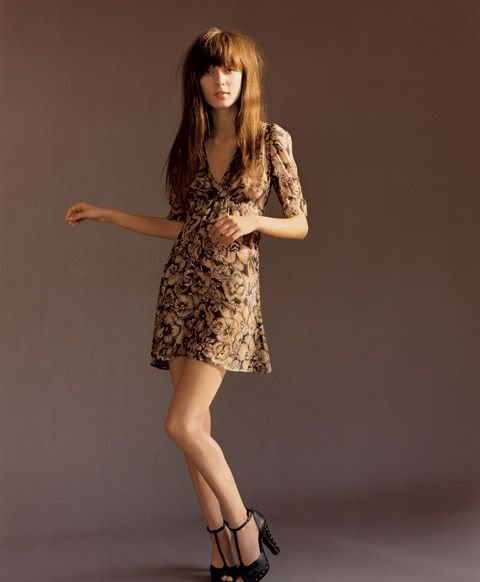
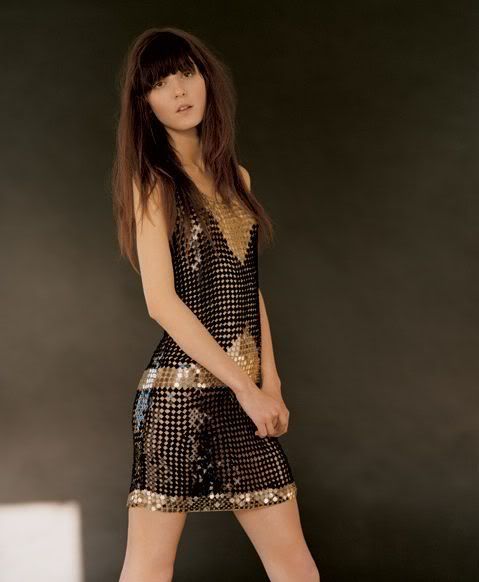
It's Kate Moss through and through. I'm not concerned
how much of a 'hand' she put into the design of the collection
because in my eyes, the clothes have achieved what they
were supposed to. They evoke Kate Moss. They are 'so Kate
Moss'. The trouble is for me, and for a few others (Philip
Green, boss of Topshop, certainly won't be concerned
because I believe we are in a minority) is that...well...to
be honest, I never wanted to evoke Kate Moss and she
has never been an inspiration for me. I like her style fine.
She pulls everything together very well. But she has never
really rocked my socks off in a way that she does for so
many. Her name is so often dropped in best dressed lists,
style icons that the Kate Moss broken record playing, for
me has made me slightly blase about it all. I'm not doubtful.
I'm just indifferent. However, fantastic news if you are
looking to channel a particular incarnation of Kate Moss.

There's 'vaguely hippy/summery' Moss.


The 'flirty/slightly slutty' Moss.


There's 'sexy boyish' Moss.


There's 'classic off-duty' Moss.


There's 'fashion forward/edged up' Moss.


If I had to choose one incarnation, I think I'd go

for the last but only because judging from the
pictures, those are the pieces that work for me
and stand out in terms of original design. Sadly,
for me, the rest of it is too much like what Topshop
have been churning out season after season in
their normal lines. As Ms Moss has said, she is
fully aware that Topshop have been evoking her
style in their design and now she is just finally
putting the official stamp on it all. I'm sure for
many people, the official stamp is enough to
induce them to go queuing and snatching on May
1st. I'd be interested to see to what extent the
clamor and excitement will be.

L.A. Fashion Week Roundup

from Style Dash

LOS ANGELES


By Sarah J. Gim

I am familiar with Literature Clothing, but know it for its graphic-printed t-shirts, sweatshirts, and hoodies and mostly casual pants. Seeing the Literature Fall 2007 collection during LA Fashion Week at Smashbox Studios was a little bit of a surprise, though I expected something different from a line called "Literature Noir." Everything was a little more dressed up. The women were in short little skirts and dresses, with a featured black print on nude/khaki (right, in the image above) that showed up on several babydolls and a long gown. In fact, I almost fell over myself for the babydoll shown. Some of the pieces were a little odd, like the black smock shown in the middle, which looked a little too much like a smock you'd throw on at the beauty parlor, particuarly with the hair styling on the models. Otherwise, not a bad showing from Literature Noir for Fall 2007.

________________


Alvin Valley's Fall 2007 collection, while at first did almost nothing for me, is kind of growing on me. I thought the colors were typical and the designs somewhat boring except the strange shape on the voluminous pants, but after thinking about it for a while, I realized that while it was rather ho-hum, they were all very wearable. I love the loose comfort of cowl necks, simple dresses, and especially the smart little silver dress in the middle of the photos above. The dress is pretty, no doubt, even girlish with that big fat bow at the waist, but how much can you love pockets on an evening-ish dress?

________________


I think I might have found the collection that made my Fashion Week: Joey Tierney
.Granted, it's not often, no, pretty much it never happens, that an entire collection will make me say "yes," and though Joey Tierney's Fall 2007 collection wasn't 100% perfect, I liked a lot of it. Tierney's palette was mostly black with some rich jewel-ized green. I am not fond of wearing green, but it was a nice refreshing change from all the typical autumn colors. I'm getting a little tired of shorts, but I loved all her use of sheers, whether it was lace shirt or sheer fabric on an evening gown, not that I could actually see someone wearing a sheer gown in public like that. Then again, this is LA and anything goes.


4/4/07

CONSUMING PASSIONS: Gin Notes

From SlashFood


D. H. Krahn Gin


By Jonathan M. Forester

D. H. Krahn Gin is 40% abv. / 80 proof and made in the USA in small batches. Krahn uses French, custom made, Stupfler alembic copper pot stills, which are considered some of the best. Many gins brag about being triple or quadruple distilled. The multiple distilling is done for a variety of reasons, but usually to make the gin as clear and neutral tasting as possible, before adding the botanicals and redistilling. D. H. Krahn says that they start with clean neutral spirits and then add the botanicals. After which the gin is only distilled once to "preserve the fragile aromas and precious essential oils of the botanicals--essences that are lost each time a spirit is distilled." Then the gin sits for three months after distilling to meld and mellow.

The product was created by two Cornell students, Dave Hughes and Scott Krahn who were designing a unique brand for a class project and decided upon a premium gin. They became so enthusiastic about the class project that after graduation they pursed the dream, to create the product in reality.

The botanicals used in D. H. Krahn, as listed on their website are: "Jumbo Italian Juniper Berries, Moroccan Coriander Seed, Floridian Oranges, Californian Lemon and Grapefruit, and rounded out with a touch of Thai Ginger."

The aroma is sweet, smooth, light, and round. It has light juniper, mild spice, and a sweet fruit and citrus profile. It's a very soft and pleasing scent that develops a nice, mildy musky tone as it opens up, with the citrus becoming more evident.

The taste is light, clean, and exceptionally smooth--complex and well balanced with the botanicals bleeding well. Not one component overwhelms any of the others so you get a gin that is different from the norm, but all gin in taste. It is a very pleasant gin that will appeal to those who want something a bit more refined and elegant. A gin that isn't overpowering. This gin is best for sipping straight on the rocks or in a very dry martini, and would be wasted in mixed drinks.

D. H. Krahn can be found in many NY liquor stores and on the net at http://www.bevmax.com/. I do have to say that they have the most silly and annoying website. http://www.dhkrahn.com/ It's all about fashion and dating, but any real information on the product was buried in the last place you come to. The last line of the last topic heading. That's trying a bit too hard to make their product seem above the rest in my opinion.